Meeting details
Date: January 27, 2026
Topic: Chemical Spill Containment Best Practices
Goal: This toolbox talk on chemical spill containment will review the chemical spill at Veolia Water Technologies Facility in New Philadelphia, Ohio, and equip supervisors with strategies to prevent similar accidents in 2026.
The incident: what happened?
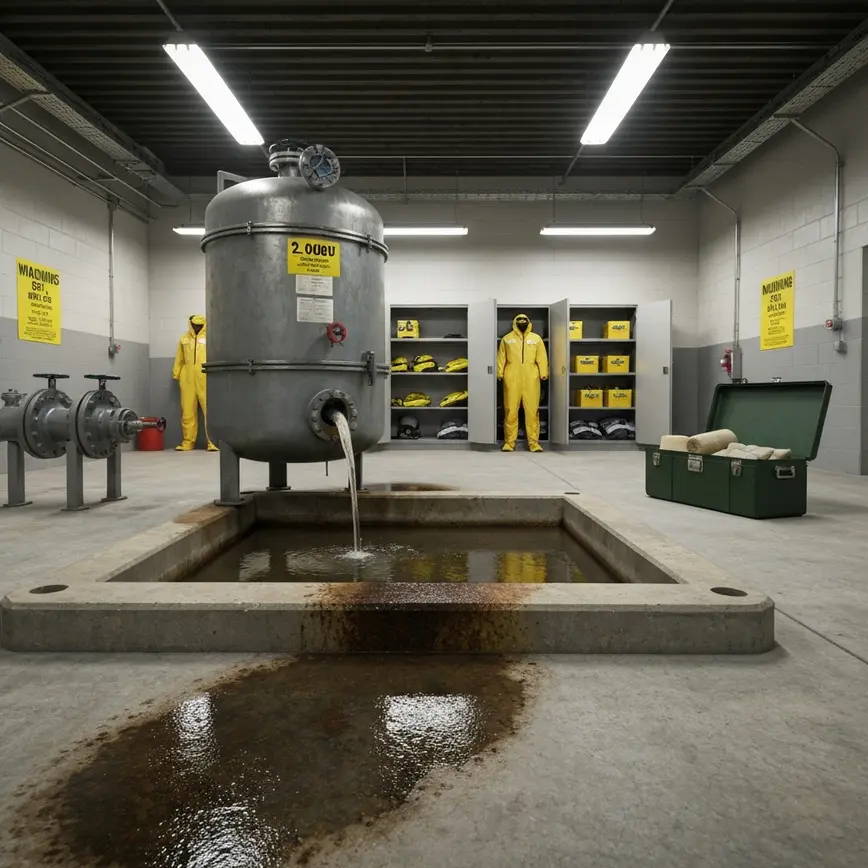
On Saturday, January 10, at 12:38 p.m., a chemical spill occurred from a 2,000-gallon tank containing acid at the Veolia Water Technologies and Solutions facility on Reiser Avenue in New Philadelphia, Ohio. Initially reported as a structure fire, first responders quickly identified it as a tank leak upon arrival. Effective chemical spill containment was achieved internally by the facility’s secondary containment system, which prevented the acid from spreading beyond the building floor. Company assessments confirmed no threat to air quality or the environment, averting a larger disaster.
The response escalated to a multi-agency HazMat operation due to the corrosive nature of the material. Firefighters could not enter with standard gear, necessitating HazMat suits and decontamination stations. HazMat technicians slowed the leak, while company employees handled the cleanup. Crews remained on scene for nearly three hours, with no injuries reported. The company plans to investigate the root cause to improve future chemical spill containment measures.
Core safety lesson
The incident at Veolia highlights a critical technical failure in proactive chemical storage integrity, where a leak from a 2,000-gallon acid tank demanded immediate chemical spill containment to avoid escalation. This underscores the vulnerabilities in handling corrosive substances without robust preventive systems.
The Hazard: Corrosive chemical leak from storage tank, risking spills onto floors that could cause structural damage, equipment corrosion, or uncontrolled spread if not contained.
The Control: Implement secondary containment systems such as bunding or diking around tanks, in compliance with OSHA 1910.106 and EPA SPCC regulations, to capture and contain spills effectively.
This control is non-negotiable because primary tank failures can occur due to corrosion, mechanical wear, or manufacturing defects, as potentially seen here. Without secondary containment, even a small leak escalates rapidly, endangering personnel, property, and the environment. Regular implementation ensures spills are isolated, allowing time for safe response without the need for full HazMat mobilization. Additional layers like tank integrity inspections using ultrasonic testing and leak detection sensors with automatic shutoff valves further bolster chemical spill containment, preventing the restricted access and prolonged exposure witnessed in this case. Site-specific HazMat response plans per NFPA 472 standards, including pre-staged PPE and decontamination, make these controls a comprehensive defense.
Supervisor’s discussion guide
Engage your crew with these targeted questions to drive home the lessons on chemical spill containment:
Q1: “Looking at our own equipment today, where is the biggest risk of corrosive chemical leaks from storage tanks?”
Q2: “How would a failure in chemical spill containment impact our site’s operations and nearby environment?”
Q3: “What steps have we taken to inspect our secondary containment systems, and when was the last check?”
Q4: “If a leak like the Veolia incident occurred here, what would our immediate response plan look like?”
Action plan & inspection
Immediately following this toolbox talk, conduct these 5 critical checks to strengthen chemical spill containment on site:
- Inspect all chemical storage tanks for signs of corrosion, leaks, or structural weaknesses, documenting findings with photos and dates.
- Verify secondary containment systems (bunding, diking) around tanks are intact, free of cracks, and capable of holding 110% of the largest tank volume per EPA SPCC rules.
- Test leak detection sensors and automatic shutoff valves on acid or corrosive material tanks for proper function.
- Review and update site-specific HazMat response plans, ensuring pre-staged PPE, decontamination stations, and NFPA 472-compliant procedures are current.
- Conduct a walkthrough of high-risk areas to confirm warning signage, spill kits, and emergency eyewash/shower stations are accessible and stocked.
Key takeaways
The Veolia incident proves that robust chemical spill containment through secondary systems and proactive inspections can limit damage and avoid injuries, even in worst-case leaks from large tanks like the 2,000-gallon acid container involved. No injuries occurred because the spill was contained internally, but reliance on post-incident HazMat response highlights the need for prevention over reaction. Supervisors must prioritize OSHA and EPA-compliant controls to eliminate hazards before they escalate.
Commit to daily vigilance: regular tank integrity checks, drilled response plans, and crew training ensure our sites exceed standards for chemical spill containment. In 2026, zero tolerance for unchecked risks will define safe operations—make it your mission to inspect, maintain, and prepare today.
Source & Disclaimer: This toolbox talk is for educational purposes based on public report. Read Original Report