Meeting details
Date: January 19, 2026
Topic: Dough Mixer Safety Protocols
Goal: This toolbox talk on dough mixer safety will review the tragic death of 71-year-old pastry chef Mordehay Grunberger in an industrial dough mixer incident at the South Florida Kosher Market and prevent similar accidents in 2026.
The incident: what happened?
On January 16, 2026, a 71-year-old pastry chef named Mordehay Grunberger lost his life in a preventable accident at the South Florida Kosher Market in North Miami Beach, Florida. The incident involved an industrial dough mixer, highlighting critical failures in dough mixer safety. Multiple 911 calls reported the emergency, with witnesses describing the chef becoming entrapped in the machine’s moving parts. North Miami Beach police responded quickly, confirming no signs of foul play after their investigation.
The Occupational Safety and Health Administration (OSHA) is actively investigating the scene to determine the exact root causes, but early reports point to unguarded moving parts, possible lack of emergency stops, and inadequate training procedures. This heartbreaking event underscores the lethal risks of bakery equipment when basic dough mixer safety measures are not enforced, serving as a stark reminder for all site supervisors to prioritize these protocols daily.
Core safety lesson
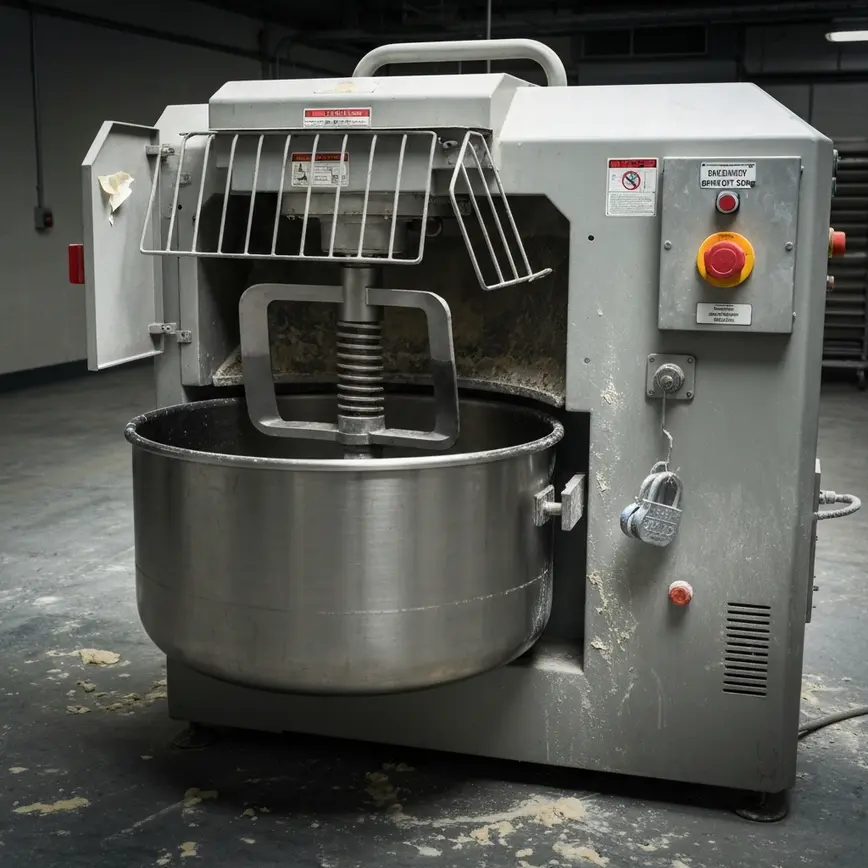
The technical failure in this incident stems from three primary hazards associated with industrial mixers: unguarded or accessible moving parts like rotating blades or agitators, absence of effective emergency stop mechanisms or lockout/tagout (LOTO) procedures, and insufficient training for operators, particularly older workers or independent contractors.
The Hazard: Unguarded moving parts of industrial mixers that can entrap limbs or entire bodies; lack of emergency stops or LOTO during cleaning/maintenance; inadequate hands-on training on equipment-specific risks.
The Control: Install interlocked guards that shut off power when opened; mandate accessible emergency stop buttons and strict LOTO protocols to isolate energy before servicing; provide documented hands-on training, certification, and refreshers on safe operations and emergencies.
These controls are non-negotiable because moving parts in dough mixers operate at high speeds and torques, capable of causing fatal entrapments in seconds—guards with interlocks ensure no access during operation, directly preventing the entrapment seen in this case. Without LOTO, residual energy can restart machines unexpectedly during cleaning, a common phase for such accidents; emergency stops provide immediate shutdowns, buying critical seconds. Training bridges the gap for all workers, especially veterans like the 71-year-old victim, by embedding hazard recognition into muscle memory, reducing errors born of familiarity or fatigue. Enforcing dough mixer safety through these measures isn’t optional—it’s the line between life and tragedy, as proven by OSHA’s ongoing probe.
Supervisor’s discussion guide
Use these questions to engage the crew for 3-4 minutes, encouraging honest input on our site’s dough mixer safety practices:
- Q1: “Looking at our own equipment today, where is the biggest risk of unguarded moving parts or failed interlocks?”
- Q2: “Have you ever cleaned or maintained a dough mixer without confirming LOTO was applied? What stopped you?”
- Q3: “How confident are you in recognizing dough mixer safety hazards during operation, and when was your last refresher training?”
- Q4: “What one change could we make today to ensure emergency stops are always accessible and tested?”
Action plan & inspection
Immediately after this toolbox talk, conduct these 5 mandatory checks on all dough mixers and related bakery equipment. Document findings and corrections:
- Verify interlocked guards are present, functional, and shut off power when opened—test each mixer.
- Inspect emergency stop buttons for accessibility (within arm’s reach) and test responsiveness.
- Review LOTO procedures: confirm energy isolation kits are available and stations are stocked with tags/locks.
- Audit training records: ensure all operators have current certification on dough mixer safety, with refreshers scheduled if over 12 months old.
- Examine mixers for wear on agitators/blades and post warning signs on all access points.
Key takeaways
Dough mixer safety demands unwavering commitment to guards, LOTO, and training— the death of Mordehay Grunberger on January 16, 2026, proves that skipping these invites catastrophe. Supervisors must lead by inspecting daily, enforcing protocols without exception, and fostering a culture where every crew member calls out risks immediately.
Remember, OSHA’s investigation reinforces that these aren’t suggestions but legal and ethical imperatives. By implementing interlocks, emergency stops, rigorous LOTO, and documented training today, we honor the fallen and safeguard our teams for 2026 and beyond. Zero tolerance for shortcuts equals zero fatalities.
Source & Disclaimer: This toolbox talk is for educational purposes based on public report. Read Original Report