Meeting details
Topic: Immediate Review of the Toolbox Talk on Preventing the **Fatal Four Construction Hazards**
Date: January 08, 2026
Goal: This toolbox talk on fatal four construction hazards will review the recent tragic fatality at Converse Elementary School and reinforce critical prevention strategies to ensure we prevent similar accidents in 2026.
The incident: what happened?
On January 7, 2026, the construction industry suffered another tragic loss. A 63-year-old construction worker, Baltazar Rubio-Olvera, died while working on the Converse Elementary School campus, a Judson ISD project where DL Bandy is the general contractor. While the specific cause of death remains pending investigation by the Bexar County Medical Examiner’s Office and local authorities, this incident serves as a stark reminder that we must proactively control the highest-risk activities on site. These high-risk activities are commonly categorized as the **fatal four construction hazards**—the four leading causes of worker deaths.
The fatality occurred on an active public infrastructure site involving multiple contractors. When investigations are pending, we cannot wait for the final report to act. We must immediately double down on our fundamental safety protocols, particularly those related to heavy equipment operation, material handling, and site traffic management, which fall under the Struck-by/Caught-in categories. The presence of multiple trades and ongoing public access demands heightened vigilance from every supervisor and worker on site.
Core safety lesson: Preventing Struck-by Incidents
The Hazard: Struck-by/Caught-in/Between incidents, which involve risks associated with heavy equipment, moving vehicles, or collapsing materials on an active site.
The Control: Strict site traffic management protocols, clear demarcation of exclusion zones, and mandatory use of spotters/signal persons when heavy machinery is operating near workers.
The control of heavy equipment movement is non-negotiable. Every worker must assume that heavy machinery operators cannot see them unless direct visual confirmation is made. This requires strict adherence to designated pedestrian walkways and exclusion zones. If a piece of equipment, such as a forklift, excavator, or crane, is operating, there must be a designated spotter or signal person whose sole job is to guide the operator and ensure no personnel enter the swing radius or path of travel. Failure to use a spotter when reversing or operating near personnel is a direct violation of our zero-tolerance policy.
Furthermore, material staging must be secure. Collapsing materials—whether stacked lumber, piping, or excavated soil—are a major contributor to the **fatal four construction hazards**. Supervisors must inspect all material stacks daily to ensure proper height-to-base ratios and secure banding. Excavation spoils must be kept at least two feet back from the edge of the trench to prevent roll-ins, which can lead to catastrophic caught-in incidents. We must treat every moving vehicle and every stacked material pile as a potential source of catastrophic energy.
Supervisor’s discussion guide
Use these questions to facilitate a brief, focused discussion with your crew:
- “Looking at our own equipment today, where is the biggest risk of a Struck-by incident? Specifically, where do pedestrians and heavy equipment paths intersect?”
- “When was the last time we reviewed our site-specific traffic plan, including designated haul routes and exclusion zones?”
- “Beyond Struck-by incidents, what is the single most critical control we must enforce today to mitigate the **fatal four construction hazards** on this specific job site?”
- “If you witness a co-worker violating a basic safety rule (like not using a spotter or standing under a suspended load), what is your immediate action, and why can you not wait for the supervisor to intervene?”
Action plan & inspection
Immediately following this toolbox talk, supervisors must verify the following five items:
- Confirm all heavy equipment operators have conducted pre-shift inspections and that all backup alarms and horns are fully functional.
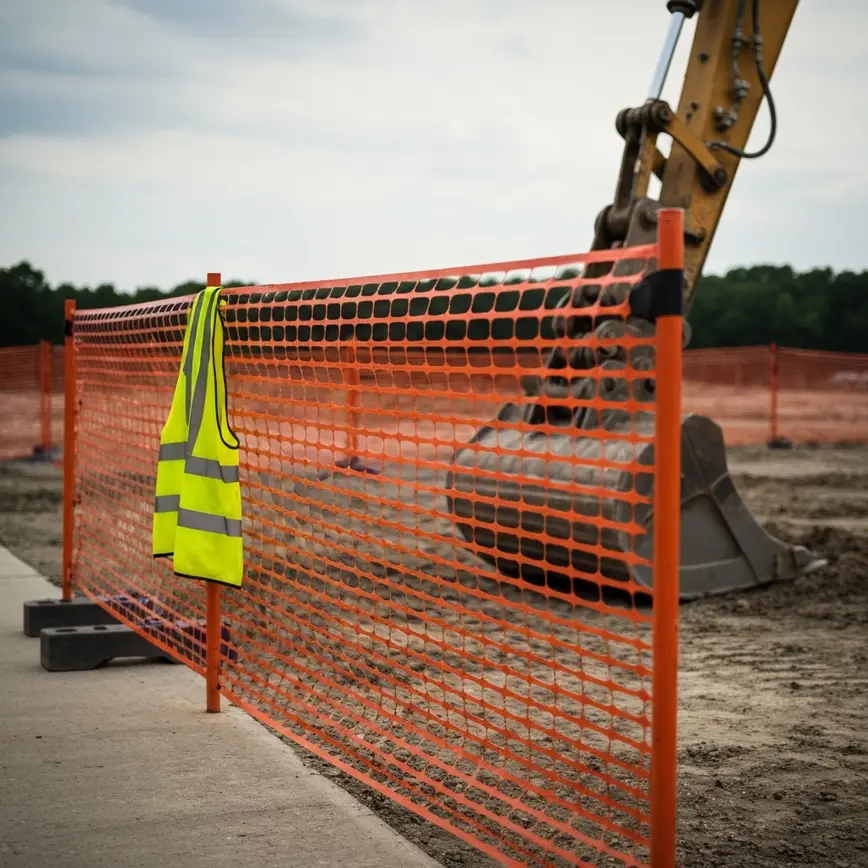
- Verify that all active swing radii for cranes or excavators are clearly marked with caution tape or physical barriers, establishing mandatory exclusion zones.
- Inspect all material staging areas to ensure proper stacking and securing, eliminating the risk of collapse or roll-out.
- Review the site’s Fall Protection Plan and confirm all workers above six feet have inspected and properly donned their Personal Fall Arrest Systems (PFAS), addressing the leading cause among the **fatal four construction hazards**.
- Ensure all personnel working near traffic or heavy equipment are wearing high-visibility vests.
Key takeaways
The tragedy in Converse reminds us that safety is not a checklist—it is an active, continuous process. Every single worker, from the laborer to the General Contractor, shares the responsibility for identifying and controlling risks. We must maintain absolute vigilance regarding the **fatal four construction hazards**: Falls, Struck-by, Caught-in/Between, and Electrocution. These four categories account for the vast majority of construction fatalities, and controlling them requires zero tolerance for shortcuts.
Our commitment to safety must be reinforced daily. Take the time to look up, look around, and look out for your colleagues. If you see something unsafe, stop the work immediately. We are committed to ensuring every worker returns home safely to their family at the end of every shift. Let’s make 2026 a year defined by proactive safety compliance, not reactive incident response.
Source & Disclaimer: This toolbox talk is for educational purposes based on public report. Read Original Report