Meeting details
Topic: Critical Review of Powered Industrial Truck Safety: Preventing Forklift Battery Fires
Goal: This toolbox talk on preventing forklift battery fires will review a serious incident involving thermal runaway and prevent similar accidents in 2026.
The incident: what happened?
On June 27, 2024, a serious incident occurred at an HD Supply warehouse in Forest Park, Georgia, involving a powered industrial truck. During operations, a forklift battery allegedly overheated significantly, producing heavy smoke and requiring immediate intervention with fire extinguishers. This thermal event highlights the catastrophic risks associated with improper battery management and the critical need for robust procedures aimed at preventing forklift battery fires. The incident resulted in an alleged lasting back injury to employee Quinton J. Hall, underscoring the severe physical consequences that equipment failure can impose.
Further analysis of the facility’s safety record reveals systemic concerns. Prior to the battery fire, the location had already been subject to an OSHA inspection, opened on May 6, 2024, which cited the facility for multiple violations of 29 CFR 1910.178. Specifically, citations included leaving powered industrial trucks unattended (29 CFR 1910.178(m)(5)(ii)). While distinct from the battery failure itself, these citations point toward a broader deficiency in adhering to fundamental operational safety standards, which can contribute to equipment misuse and subsequent failure.
Core safety lesson: controlling thermal hazards and operational compliance
The Hazard: Forklift Battery Fire/Thermal Runaway and Unsafe Powered Industrial Truck Operation.
The Control: Implement dedicated, ventilated battery charging areas with appropriate fire suppression systems, strict maintenance schedules, and mandatory compliance with 29 CFR 1910.178 operational standards.
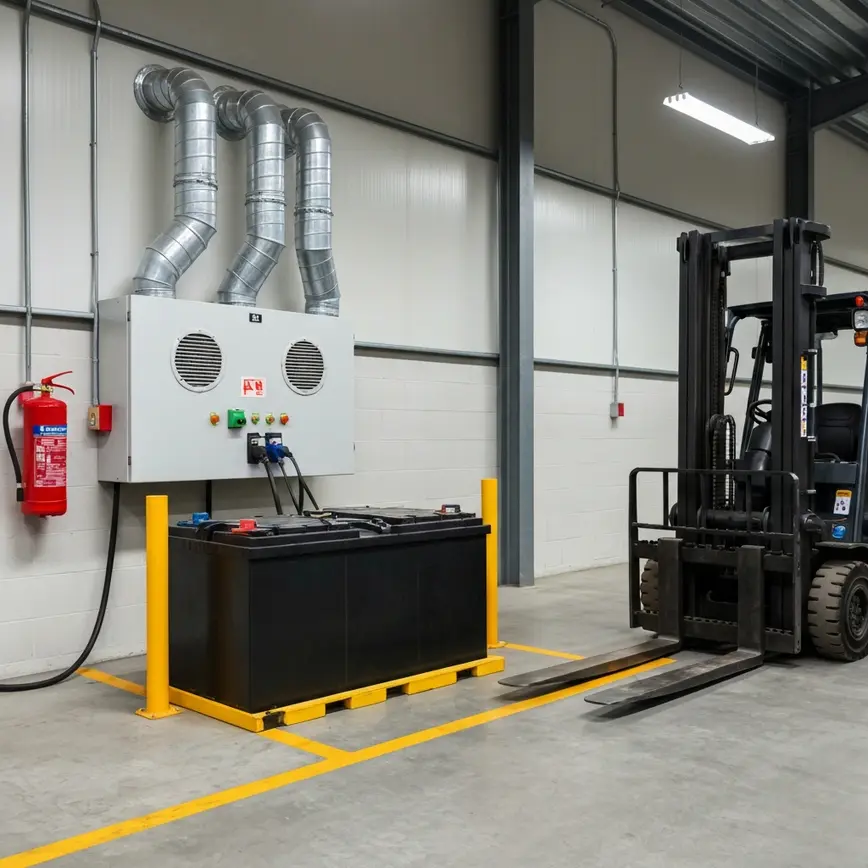
The primary technical failure in this case is thermal runaway—the rapid, uncontrollable rise in temperature within a battery cell. This is often caused by overcharging, internal short circuits, or physical damage. To mitigate this, our control focuses on the environment. We must use dedicated charging areas that are well-ventilated to dissipate heat and hydrogen gas, and these areas must be equipped with specialized fire suppression systems, as standard water extinguishers are often ineffective or dangerous for lithium or lead-acid fires.
However, the regulatory context shows that equipment failure is often compounded by operational failure. The citation for leaving powered industrial trucks unattended (29 CFR 1910.178(m)(5)(ii)) is non-negotiable. An unattended, running forklift is susceptible to tampering, unauthorized use, or unnoticed mechanical stress that could accelerate battery failure. If an operator leaves the truck for any reason, they must secure it completely: turn off the power, lower the forks, set the brake, and remove the key.
Strict adherence to these operational and maintenance controls is the only way of truly preventing forklift battery fires. We must treat battery maintenance and charging procedures with the same seriousness as we treat driving safety. A proactive maintenance schedule that monitors battery temperature, fluid levels, and casing integrity is essential to catch early signs of overheating before they escalate into a catastrophic fire event.
Supervisor’s discussion guide
Use these questions to facilitate a brief discussion and gauge crew understanding:
- Q1: Looking at our own equipment today, where is the biggest risk of thermal runaway or battery overheating?
- Q2: Can someone explain the exact procedure for securing a powered industrial truck if you must leave it unattended for more than 25 feet or five minutes? (Reference 29 CFR 1910.178(m)(5)(ii)).
- Q3: If a battery begins smoking or showing signs of thermal distress, what is the immediate emergency action plan, and where is the correct type of fire extinguisher located for preventing forklift battery fires?
- Q4: How often are we visually inspecting battery casings, connectors, and ventilation ports for damage or debris during pre-shift checks?
Action plan & inspection
The following items must be verified immediately following this toolbox talk:
- Verify that all keys are removed from powered industrial trucks when they are not in use or are left unattended (secured).
- Inspect the dedicated battery charging area to ensure ventilation systems are operational and clear of obstruction.
- Confirm that the appropriate class of fire extinguisher (e.g., Class D for metal fires, or specific chemical agents for lithium-ion) is present and accessible within 25 feet of the charging station.
- Review the maintenance log for all PIT batteries to ensure scheduled temperature and fluid level checks are current.
- Drill the emergency evacuation route specifically for the battery charging area, ensuring all personnel know how to safely retreat from smoke exposure.
Key takeaways
Safety is a system, not a suggestion. The incident in Georgia demonstrates that equipment failure, specifically thermal runaway in batteries, carries severe consequences, including lasting physical injury. Our commitment to preventing forklift battery fires starts with rigorous maintenance. We must ensure batteries are charged correctly, never overcharged, kept clean, and that any signs of heat, swelling, or damage are reported immediately to maintenance personnel. Do not attempt to operate a truck with a compromised power source.
Furthermore, operational discipline is paramount. Every operator is responsible for complying with 29 CFR 1910.178. Never leave a powered industrial truck running and unattended. Securing the equipment prevents unauthorized use and ensures that if a failure does occur, it happens in a controlled state, limiting the risk to personnel. We must close the gap between maintenance procedures and daily operational habits to ensure a safe working environment in 2026.
Source & Disclaimer: This toolbox talk is for educational purposes based on public report. Read Original Report