meeting details
Topic: Pedestrian-Vehicle Interaction and Commercial Driving Standards
Goal: To review the $10.2 million Houston delivery truck settlement and prevent similar pedestrian-strike accidents on our site.
the incident: what happened?
Script: “Listen up everyone. We are reviewing a serious report from Houston, Texas, involving a catastrophic pedestrian-vehicle collision that recently resulted in a $10.2 million settlement. A man was attempting to be a good Samaritan by assisting a delivery driver who was lost and unable to locate a specific home. The victim approached the truck while waving his arms to signal the driver. Despite this visible attempt to communicate, the driver continued moving forward without slowing down or establishing eye contact. The man was run over by the delivery truck, suffering life-altering injuries.”
Script: “The subsequent lawsuit revealed a total failure in basic commercial driving standards. The driver failed to maintain a proper lookout and failed to yield the right-of-way to the pedestrian. Furthermore, the companies responsible for the vehicle were cited for systemic failures in their hiring, training, and supervision processes. This incident proves that a split-second lapse in focus—combined with a failure to respect vehicle blind spots—can lead to a lifetime of physical trauma and tens of millions of dollars in legal liability.”
core safety lesson
The technical failure in this incident centers on the “No-Zone” and a breakdown in “Positive Communication.” Large delivery vehicles have significant blind spots directly in front, behind, and on both sides. When a driver is distracted—in this case, likely by searching for an address or navigating via GPS—their situational awareness is compromised. They stop scanning the environment and start making “assumption-based” movements, assuming the path is clear simply because they didn’t see an obstacle in their primary line of sight.
The Hazard: Blind Spots (No-Zones) and Distracted Driving.
The Control: Safe Interaction Protocols and Defensive Driver Training.
These controls are non-negotiable because a human body will never win a fight against a multi-ton delivery vehicle. We utilize the “Smith System” of defensive driving, which mandates “keeping the eyes moving” and “making sure they see you.” If a driver cannot confirm the location of a pedestrian through direct eye contact or verbal confirmation, the vehicle must not move. Furthermore, our policy requires drivers to bring the vehicle to a full stop and place it in park before engaging with any pedestrian. This eliminates the risk of the vehicle “creeping” forward while the driver is distracted by a conversation.
supervisor’s discussion guide
Q1: “Looking at our own site traffic and delivery zones today, where is the highest risk of a pedestrian entering a driver’s blind spot?”
Q2: “If you are waving at a driver and they don’t wave back or acknowledge you, what should your next move be?”
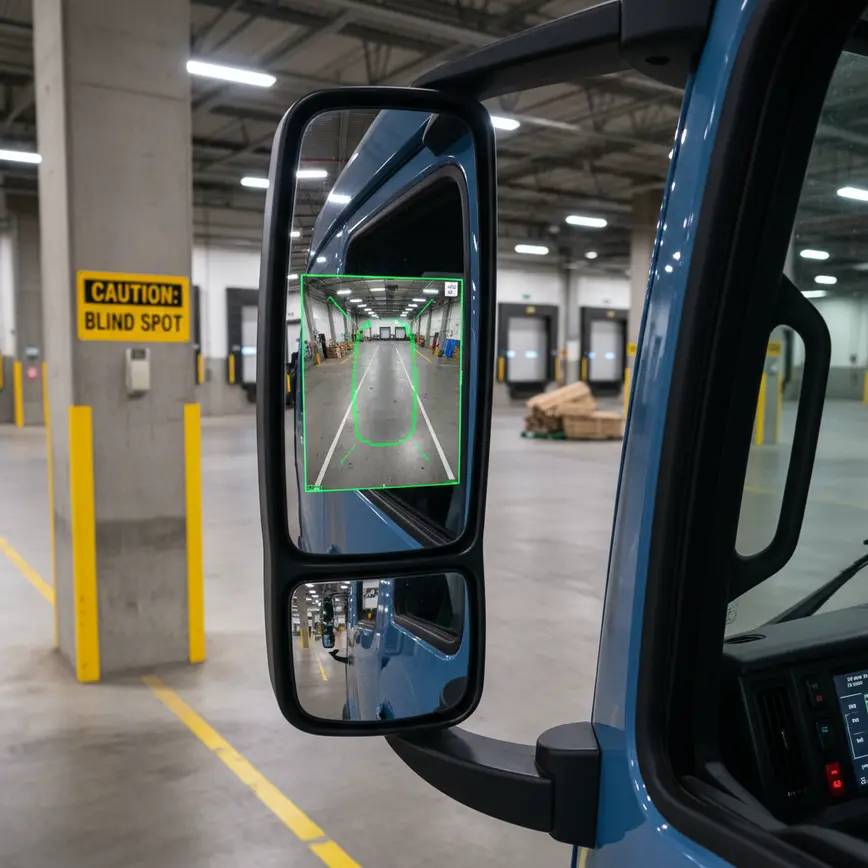
Q3: “Why is it dangerous to rely solely on a backup camera or a single mirror when moving a truck in a residential or crowded work zone?”
Q4: “If you see a coworker approaching a moving vehicle to talk to the driver, how should you intervene?”
action plan & inspection
- Inspect Vehicle Tech: Verify that all 360-degree camera systems and proximity sensors are clean and fully operational.
- Mirror Check: Ensure all side and front-view mirrors are adjusted specifically to the current driver’s height and seating position.
- Training Audit: Confirm all operators have completed their defensive driving and “Smith System” refresher courses.
- Communication Protocol: Re-establish the “Full Stop/In Park” rule for all personnel interacting with delivery or site vehicles.
- Site Signage: Inspect pedestrian walkways to ensure they are clearly marked and separated from high-traffic delivery routes.
Source: Read Original Report