meeting details
Topic: Lessons from the London Bagel Museum Crisis: Preventing Industrial Bakery Accidents
Goal: To review the systemic safety failures at the London Bagel Museum and implement rigorous controls to prevent musculoskeletal injuries, thermal burns, and mechanical entrapment on our site.
the incident: what happened?
Script: “Listen up everyone. We are reviewing a serious report regarding a significant safety crisis at the London Bagel Museum. Over the past four years, this facility recorded a staggering 63 industrial accidents. This wasn’t just bad luck; it was a systemic failure of safety management and a culture that prioritized production over human life. Most tragically, these conditions led to the death of an employee in their 20s. The data shows a facility plagued by overwork, where staff were forced to perform three-person tasks with only two people, and individuals were subjected to repetitive strain, such as applying syrup for six consecutive hours without relief.”
“The accident reports reveal specific, preventable injuries: seven workers suffered thermal burns because management provided inadequate safety gloves, and six workers had their hands caught in dough processing machinery. Perhaps most telling is that over 50% of these injuries involved employees with less than one year of experience. This proves that a lack of proper onboarding, inadequate training, and a failure to protect new workers are direct precursors to industrial accidents. We are here today to ensure that the ‘production at all costs’ mentality never takes root on this site.”
core safety lesson
The technical failures at the London Bagel Museum fall into three high-risk categories: Ergonomic Strain, Thermal Hazards, and Mechanical Entrapment. The root cause was a failure to implement “Engineering Controls” and “Administrative Controls,” relying instead on overworked employees to navigate hazardous environments without the proper tools or staffing levels. When you force two people to do the work of three, you aren’t just increasing productivity; you are increasing the physical load on their musculoskeletal systems, leading to long-term disability.
The Hazard: Mechanical Entrapment and Thermal Energy.
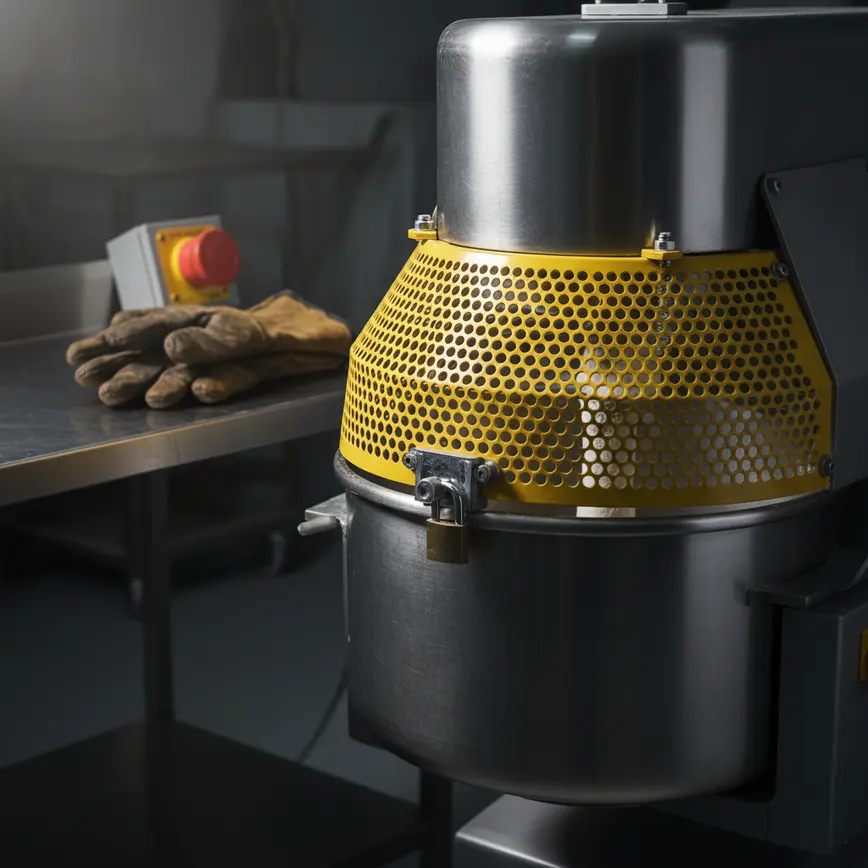
The Control: Physical Machine Guarding, Interlocks, and Certified PPE.
These controls are non-negotiable because they account for human error. A worker who has been performing a repetitive task for six hours will experience “highway hypnosis” or extreme fatigue, making them prone to mistakes. Physical guards and interlock systems on dough mixers ensure that even if a worker reaches into a danger zone, the machine cannot operate. Similarly, PPE is the last line of defense; if management provides gloves that do not meet industrial heat-resistance standards, they have effectively removed that defense. We do not “make do” with substandard gear, and we do not bypass guards to save time.
supervisor’s discussion guide
Q1: “Looking at our own dough processing and heavy lifting areas today, where do you feel we have the highest risk of repetitive strain or ergonomic injury?”
Q2: “If you noticed that a new hire—someone with less than six months on the job—was performing a task incorrectly or unsafely, what is your specific responsibility to intervene?”
Q3: “Management at the museum admitted their gloves were inadequate. If you find that your PPE is worn out or not fit for the heat levels you’re working with, what is the immediate process for replacement?”
Q4: “We saw six instances of hands caught in machinery. If you saw a coworker bypassing a safety guard or interlock to clear a jam, would you stop the line immediately?”
action plan & inspection
- Staffing Audit: Verify that all heavy labor tasks (dough handling/lifting) meet the minimum staffing requirements. No two-person tasks are to be performed by a single individual.
- Machine Guarding Check: Inspect all dough mixers and processing equipment to ensure physical guards are in place and interlock sensors are functioning correctly.
- PPE Certification Review: Audit all heat-resistant gloves in the baking area. Any gloves showing signs of degradation or lacking industrial heat-rating stamps must be discarded and replaced.
- Task Rotation Schedule: Confirm that task rotation is occurring every two hours for repetitive roles (syrup application, packing, etc.) to prevent musculoskeletal strain.
- New Hire Mentorship: Identify all employees with less than one year of experience on-site and verify they have completed their specific safety training for the machinery they are currently operating.
Source: Read Original Report