Meeting details
Date: February 17, 2026
Topic: Work at Height: Preventing Falls from Stepladders and Unprotected Edges
Goal: This toolbox talk on work at height will review the worker fall from height during handbag factory renovation and prevent similar accidents in 2026.
The incident: what happened?
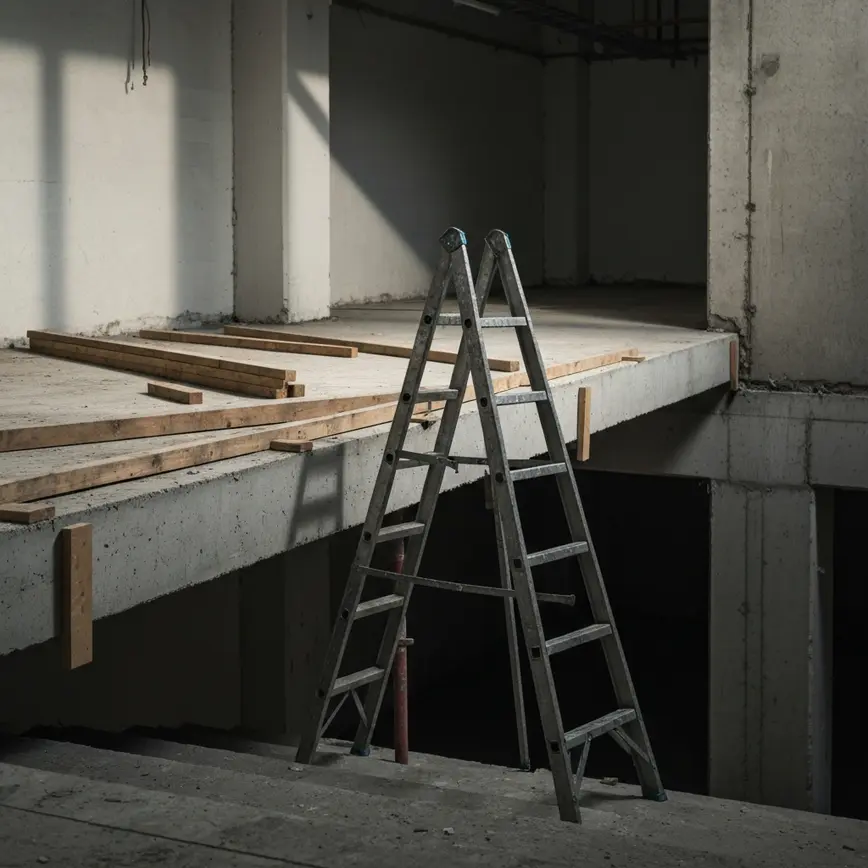
On 5 August 2021, during a refurbishment project in Islington, London, converting a domestic property and former handbag factory into a single dwelling, a worker for Bow Tie Construction Limited was engaged in work at height. He fell approximately 1.65 metres from the top of a stepladder while using a gas-powered nail gun to build temporary timber formwork for a new concrete staircase. This incident highlights the dangers of using inappropriate access equipment for tasks involving tools and materials at elevation.
The worker sustained multiple serious injuries, including crush injuries to both elbows requiring surgeries, a fractured forearm, dislocated wrists, right leg injuries, and left knee injuries. An HSE investigation revealed critical failings: no safe system of work for height tasks, inadequate edge protection, incorrectly assembled tower scaffolds, staircases without edge protection, and uncontrolled ladder use. Despite a prior HSE Prohibition Notice issued on 2 July 2021 for unsafe height work, violations continued. On 13 February 2026, the company pleaded guilty to breaching Section 2(1) of the Health and Safety at Work etc. Act 1974 and was fined £24,000 plus £4,101 costs at Southwark Crown Court.
Core safety lesson
The technical failure in this incident stemmed from using a stepladder for prolonged work at height involving a nail gun, combined with absent edge protection and poor scaffold assembly. These lapses turned a routine renovation task into a life-altering catastrophe.
The Hazard: Unstable or inappropriate ladder use (e.g., stepladders for tasks beyond short-duration, low-risk access), lack of edge protection on stairs and platforms, and incorrectly assembled scaffolds during work at height.
The Control: Conduct thorough risk assessments to select appropriate access like podium steps, scaffolds, or MEWPs; install collective protection such as toe boards, mid-rails, and top rails on all edges over 2m (or lower per site risks); ensure scaffolds are erected by trained personnel, inspected daily, and tagged before use.
These controls are non-negotiable because work at height remains one of the leading causes of construction fatalities and serious injuries. A stepladder’s inherent instability amplifies risks when using power tools, as any imbalance can lead to falls, as seen in this 1.65m drop causing multiple fractures and surgeries. Proper edge protection prevents falls entirely by containing workers, while competent scaffold assembly ensures structural integrity—skipping these invites HSE enforcement, fines, and human suffering. Supervisors must enforce method statements, training, and inspections to embed work at height safety into every site operation.
Supervisor’s discussion guide
Use these questions to engage the crew and identify site-specific risks:
Q1: “Looking at our own equipment today, where is the biggest risk of falls during work at height?”
Q2: “How can we ensure ladders are only used for short, low-risk tasks and never with power tools like nail guns?”
Q3: “What edge protection is missing on our staircases or platforms, and how do we fix it immediately?”
Q4: “Recall a time we had scaffold issues—how did inspections and tags prevent problems?”
Action plan & inspection
Immediately after this meeting, verify and action these 5 items:
- Inspect all ladders and stepladders on site for damage, secure footing, and correct use—tag out any unfit for work at height.
- Check scaffolds for proper assembly by trained erectors, daily inspections, and compliance tags; disassemble non-compliant ones.
- Install or confirm edge protection (toe boards, mid-rails, top rails) on all staircases, platforms, and openings over 2m.
- Review and update risk assessments and method statements for all current work at height tasks, specifying access equipment.
- Conduct a spot audit of supervision records to ensure competent oversight for height activities, with training refreshers scheduled.
Key takeaways
Falls from height, like the 1.65m stepladder incident in the handbag factory renovation, devastate lives and businesses—multiple surgeries, fractures, and HSE fines of £28,101 underscore the cost of complacency. Never use ladders for anything beyond quick, low-risk access; prioritize stable platforms, scaffolds, or MEWPs with full edge protection. Ignoring prior warnings, as Bow Tie Construction did post-Prohibition Notice, guarantees repeat failures.
Make work at height non-negotiable: risk-assess every task, train all levels including directors, supervise rigorously, and inspect daily. This toolbox talk commits us to zero falls in 2026—sign below to confirm understanding and accountability.
Source & Disclaimer: This toolbox talk is for educational purposes based on public report. Read Original Report