Meeting details
Date: January 23, 2026
Topic: Preventing Unguarded Machinery Entanglement
Goal: This toolbox talk on unguarded machinery entanglement will review the fatal incident at Stanley Wire Limited’s Penistone site and equip supervisors and crews with the knowledge to prevent similar accidents in 2026.
The incident: what happened?
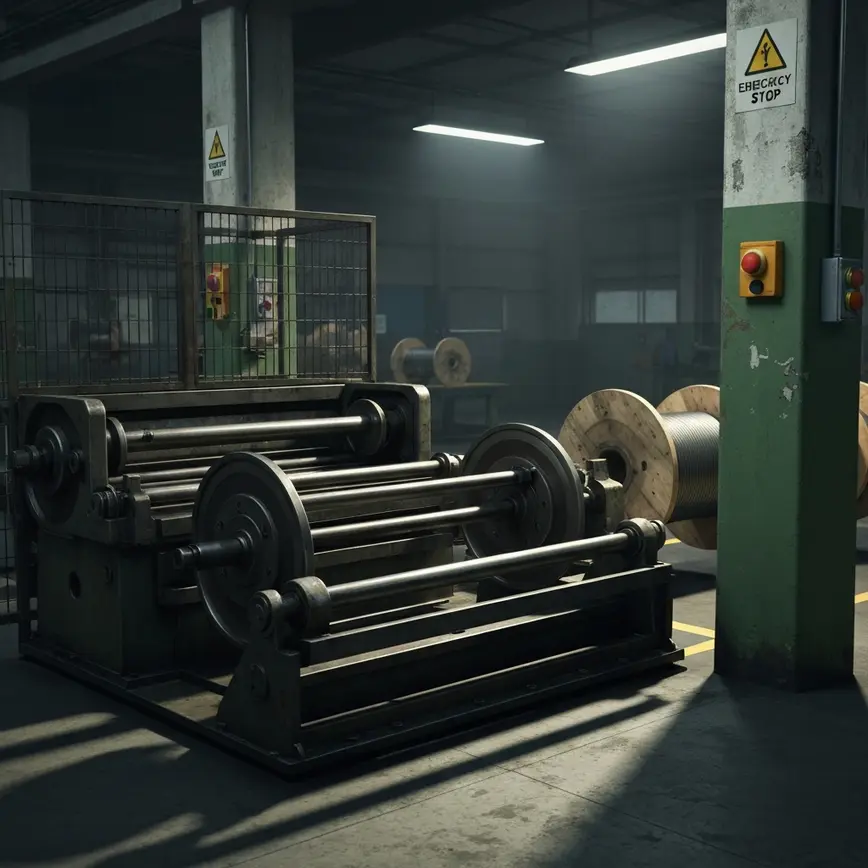
On 18 November 2021, at Stanley Wire Limited’s site on Talbot Road in Penistone, South Yorkshire, a tragic case of unguarded machinery entanglement claimed the life of 45-year-old worker David Lockwood. While operating a ‘Gravity Block’ wire drawing and recoiling machine, Lockwood became entangled in its exposed moving parts, suffering a fatal head injury. The Health and Safety Executive (HSE) investigation pinpointed the absence of any effective guards or barriers, allowing access to the rotating components during operation.
The HSE found multiple failures: no suitable risk assessment had been conducted, there was no implemented safe system of work, and the company relied solely on verbal instructions rather than formal training. These lapses breached Section 2(1) of the Health and Safety at Work etc Act 1974. Following the incident, eight Prohibition Notices were served to halt unsafe operations. On 22 January 2026, at Sheffield Magistrates’ Court, Stanley Wire Limited was fined £140,000 plus £6,652 in costs, underscoring the severe consequences of neglecting machinery safeguards.
Core safety lesson
The core failure in this incident was the complete lack of physical guards on the ‘Gravity Block’ machine, enabling unguarded machinery entanglement. This preventable oversight highlights how exposed moving parts—such as rotating drums and recoiling mechanisms—can draw in clothing, hair, or limbs with deadly force.
The Hazard: Exposure to unguarded moving parts of machinery, where workers can access rotating components leading to entanglement, crushing, or fatal injuries.
The Control: Install fixed closed guards, interlocks, or pressure mats to physically block access while the machine is operational, in line with PUWER guidance. Additional controls include thorough risk assessments, formal safe systems of work, and structured training overseen by a competent person.
These controls are non-negotiable because machinery like wire drawing blocks operates at high speeds with immense torque, creating nip points and in-running hazards that human reaction times cannot counter. Verbal warnings or “common sense” are insufficient; only engineered barriers provide reliable prevention. Industry standards have long mandated such guards, and their absence not only risks lives but invites legal action, as seen with the £140,000 fine and Prohibition Notices. Supervisors must enforce zero tolerance for unguarded machinery entanglement risks to uphold duty under the Health and Safety at Work etc Act 1974.
Supervisor’s discussion guide
Use these questions to engage the crew and apply lessons locally:
- Q1: “Looking at our own equipment today, where is the biggest risk of unguarded machinery entanglement?”
- Q2: “What would happen if someone got caught in moving parts on our wire handling or similar machines—how does this compare to the Penistone incident?”
- Q3: “Have we all received formal training on our machines’ safe systems of work, or are we relying on verbal instructions?”
- Q4: “Who is our designated competent person for machinery safety, and what checks do they perform daily?”
Action plan & inspection
Immediately after this toolbox talk, conduct these 5 checks and document findings:
- Inspect all machinery for fixed guards, interlocks, or pressure mats on moving parts—tag out any unguarded machinery entanglement risks.
- Review and update site-specific risk assessments for wire drawing, recoiling, or similar equipment, ensuring hazards like exposed rotations are addressed.
- Verify safe systems of work are documented and posted near machines—no reliance on verbal instructions.
- Confirm formal training records for all operatives on machinery hazards and controls; schedule retraining if gaps exist.
- Appoint or confirm a competent person for oversight and perform a full walk-around to serve Prohibition Notice-style halts on unsafe machines.
Key takeaways
Unguarded machinery entanglement is a lethal hazard that demands engineered controls like guards and interlocks, not hope or warnings. The Stanley Wire Limited case proves that inadequate risk assessments, missing safe systems, and poor training lead to fatalities and heavy fines—£140,000 in this instance—while breaching core legislation like Section 2(1) of the Health and Safety at Work etc Act 1974. Supervisors must lead by ensuring every machine is assessed, guarded, and trained upon.
Commit to zero tolerance: check guards daily, train formally, and appoint competent overseers. This toolbox talk reinforces that preventing unguarded machinery entanglement saves lives and avoids HSE enforcement like the eight Prohibition Notices served post-incident. Stay vigilant—safety is non-negotiable in 2026 and beyond.
Source & Disclaimer: This toolbox talk is for educational purposes based on public report. Read Original Report