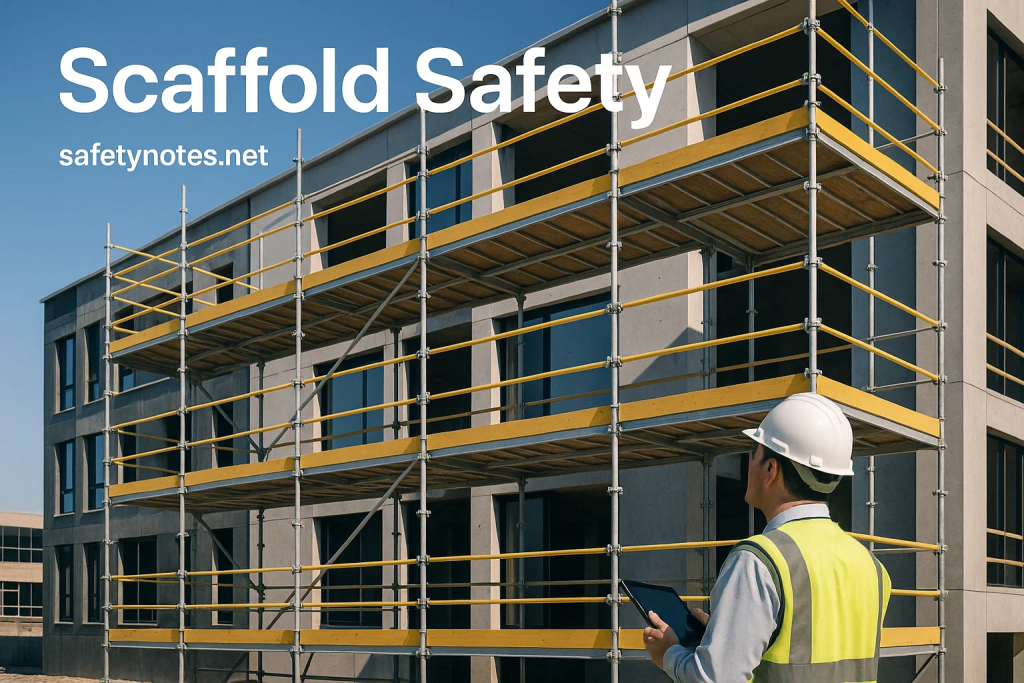
In the complex and dynamic environment of a construction site, scaffolds are an indispensable tool, providing workers with access to elevated work areas. However, these temporary structures are also a source of significant risk. Year after year, scaffolding-related incidents are a leading cause of fatalities and serious injuries in the construction industry, consistently ranking among the top violations cited by the Occupational Safety and Health Administration (OSHA).
For the Health, Safety, and Environment (HSE) professional, mastering scaffold safety is not just about compliance; it is a fundamental duty to protect lives. A structurally sound, properly erected, and correctly used scaffold is a safe and efficient work platform. Conversely, a deficient one is a catastrophic failure waiting to happen.
This comprehensive guide serves as an expert-level deep dive into the critical requirements for scaffold use in the construction industry, grounded in the authoritative standards of OSHA 29 CFR 1926, Subpart L. We will deconstruct the regulations, translating them into practical, actionable knowledge for safety officers, site supervisors, construction managers, and every worker who sets foot on a platform. Our goal is to move beyond mere checklists and foster a profound understanding of the principles that underpin true scaffold safety.
Part 1: The Foundation of Scaffold Safety: Key Roles and Responsibilities
Before a single scaffold component is assembled, a framework of responsibility must be established. OSHA meticulously defines specific roles to ensure that every phase of a scaffold’s lifecycle—from design and erection to inspection and use—is managed by individuals with the appropriate knowledge and authority.
The Role of the Competent Person (§1926.450(b))

The “Competent Person” is arguably the most critical role for the day-to-day safety of scaffold operations. OSHA defines a competent person as one who is capable of identifying existing and predictable hazards in the surroundings or working conditions which are unsanitary, hazardous, or dangerous to employees, and who has authorization to take prompt corrective measures to eliminate them.
This is not a passive title; it is an active, on-site authority. The competent person for scaffolding must have specific training and experience related to scaffold systems. Their duties are extensive and include:
- Supervising Erection and Dismantling: Directing and overseeing all employees involved in erecting, dismantling, moving, or altering scaffolds, as required by §1926.451(f)(7).
- Determining Fall Protection Feasibility: For employees erecting and dismantling supported scaffolds, the competent person must determine the feasibility and safety of providing fall protection (§1926.451(g)(2)).
- Authorizing Work in Adverse Conditions: Assessing weather conditions, such as high winds or storms, to determine if it is safe for personnel to work on or from a scaffold (§1926.451(f)(12)).
- Training Erectors: Training employees involved in scaffold erection, dismantling, and operation to recognize the associated hazards (§1926.454(b)).
- Assessing Component Integrity: Evaluating if intermixing components from different manufacturers is safe (§1926.451(b)(10)) or if galvanic action between dissimilar metals has compromised capacity (§1926.451(b)(11)).
- Conducting Inspections: Performing thorough inspections of the scaffold and its components for visible defects before each work shift and after any event that could affect its structural integrity, as per §1926.451(f)(3). This includes checking for damaged parts, insecure connections, and foundation instability. To ensure no detail is overlooked, a systematic approach is essential.
Real-World Application: A competent person notices the ground beneath a scaffold’s mud sills has become saturated from a water leak. Recognizing the predictable hazard of foundation settlement, they immediately halt work on the scaffold, barricade the area, and supervise the re-leveling and securing of the foundation before authorizing work to resume.
The Role of the Qualified Person (§1926.450(b))
While the competent person is the hands-on supervisor and inspector, the “Qualified Person” is the designer and engineer of the system. OSHA defines a qualified person as one who, by possession of a recognized degree, certificate, or professional standing, or who by extensive knowledge, training, and experience, has successfully demonstrated his/her ability to solve or resolve problems relating to the subject matter, the work, or the project.
The key distinction is design versus implementation. The qualified person performs tasks that require advanced calculation, engineering principles, and technical design knowledge. Their responsibilities include:
- Designing Scaffolds: Designing scaffolds and their components to ensure they meet the required capacity and structural standards, as specified in §1926.451(a)(6). This includes designing special-duty scaffolds not covered by standard tables.
- Designing Rigging: For certain suspended scaffolds, a qualified person must design the rigging (§1926.452(o)(2)(i)).
- Training Scaffold Users: Training employees who work on scaffolds to recognize the hazards and understand the procedures to control them (§1926.454(a)).
When is a Registered Professional Engineer Required?
For particularly complex or high-risk scaffold systems, the expertise of a Registered Professional Engineer (P.E.) is mandated. A qualified person may design many scaffolds, but an engineer’s seal is required when certain thresholds are crossed. These situations include:
- Designing pole scaffolds over 60 feet in height (§1926.452(a)(10)).
- Designing tube and coupler scaffolds over 125 feet in height (§1926.452(b)(10)).
- Designing fabricated frame scaffolds over 125 feet in height (§1926.452(c)(6)).
- Designing outrigger scaffolds and their components (§1926.452(i)(8)).
- Designing scaffolds that will be moved while employees are on them (§1926.451(f)(5)).
The involvement of an engineer in these cases provides the highest level of assurance that complex forces, such as wind loads and dynamic loads, have been properly calculated and accounted for in the design.
Part 2: The Core Principles of Scaffold Integrity (§1926.451)
A scaffold is only as safe as its weakest point. OSHA standard §1926.451 provides a comprehensive set of “General Requirements” that form the bedrock of structural safety for all scaffold types.
Scaffold Capacity and Structural Integrity: The Foundational Safety Factors
Every scaffold must be strong enough to support not just its own weight but also the considerable loads imposed upon it. This includes the weight of workers, tools, and heavy materials like bricks, mortar, or plaster.
- The 4:1 Safety Factor (§1926.451(a)(1)): This is a cornerstone principle. Each scaffold and every one of its components (platforms, bearers, legs, etc.) must be capable of supporting, without failure, at least four times the maximum intended load applied or transmitted to it. This safety margin accounts for unforeseen stresses, dynamic forces (like workers moving), and material imperfections.
- The 6:1 Safety Factor for Ropes (§1926.451(a)(3)&(4)): The requirements for suspension ropes are even more stringent. Each suspension rope on an adjustable suspension scaffold must be able to support, without failure, at least six times the maximum intended load applied to it. This higher factor acknowledges the critical, life-dependent nature of ropes and the potential for wear and tear.
- Defining the Maximum Intended Load: This is the total load of all personnel, equipment, tools, materials, and any other anticipated loads. It is the responsibility of the employer and the competent person to accurately calculate this load before work begins and ensure it never exceeds the scaffold’s rated capacity.
Real-World Application: A team of four bricklayers will be working on a platform. Each worker with tools weighs approximately 250 lbs (1,000 lbs total). They plan to load a pallet of bricks weighing 2,000 lbs. The maximum intended load is 3,000 lbs. According to the 4:1 rule, the scaffold platform and all its supporting members must be rated to support at least 12,000 lbs.
Platform Construction: Building a Safe Work Surface (§1926.451(b))
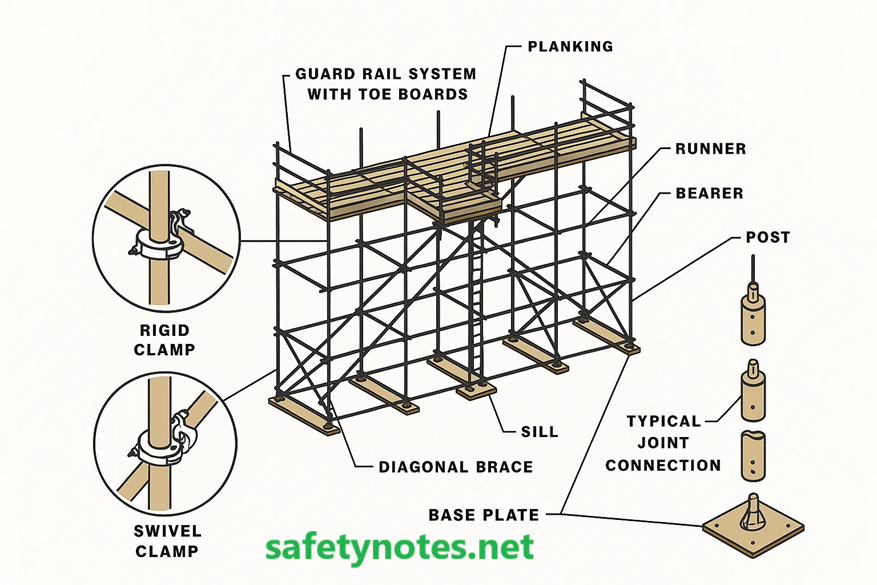
The platform is the primary work surface. Its construction is governed by strict rules to prevent collapses, slips, and falls through gaps.
- Full Planking and Decking: Each platform on all working levels must be fully planked or decked between the front uprights and the guardrail supports. The space between adjacent planking units, and between the platform and the uprights, must not exceed 1 inch. This prevents tools or feet from slipping through. An exception allows for a wider space of up to 9.5 inches when necessary to fit around uprights, such as when using side brackets.
- Platform Width: Each scaffold platform and walkway must be at least 18 inches wide. If site constraints make this impossible, the platform must be as wide as feasible, and workers must be protected by both guardrails and personal fall arrest systems.
- Front Edge Clearance: The front edge of all platforms must be no more than 14 inches from the face of the work. This minimizes the risk of workers falling between the scaffold and the structure. This distance is extended to 18 inches for plastering and lathing operations. If these distances are exceeded, a guardrail system or PFAS must be used.
- Proper Planking Practices:
- Extension Over Supports (§1926.451(b)(4)): Each end of a plank must extend over the centerline of its support by at least 6 inches.
- Cantilevering (§1926.451(b)(5)): A plank should not extend more than 12 inches beyond its support unless it is designed and secured to prevent tipping.
- Overlapping (§1926.451(b)(7)): When planks are overlapped to create a longer platform, the overlap must occur over a support and be at least 12 inches long.
- Unacceptable Platform Materials and Finishes: Wood platforms must not be covered with opaque finishes. Clear finishes are permissible, as they allow the competent person to inspect the wood for cracks, knots, or other dangerous defects.
Supported Scaffolds: Stability from the Ground Up (§1926.451(c))
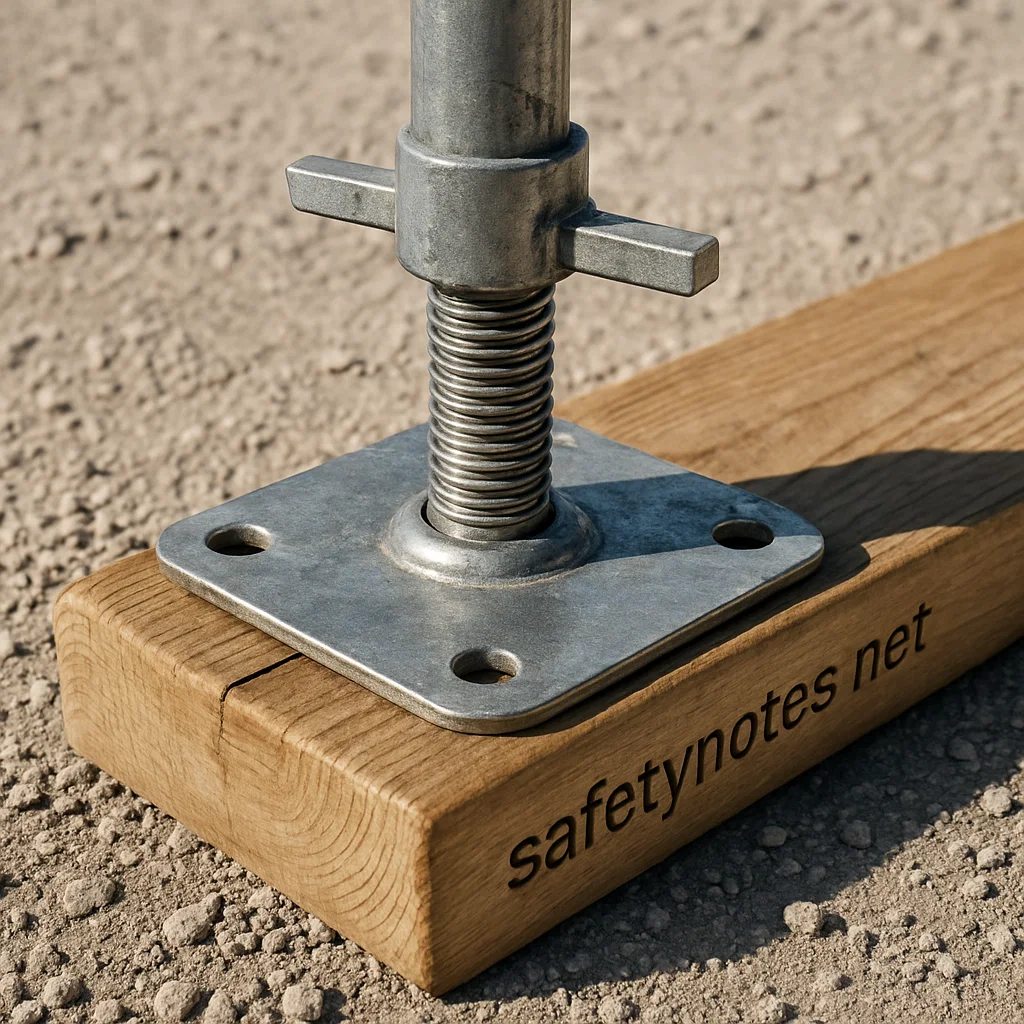
Supported scaffolds, which derive their strength from the ground, are the most common type in construction. Their stability is entirely dependent on a solid foundation and proper bracing.
- Foundation and Footings: Scaffold poles, legs, and frames must bear on base plates and mud sills or another adequate firm foundation. Mud sills (planks or pads) are crucial for distributing the concentrated load from the base plate over a wider area, preventing it from sinking into soft soil or asphalt. Unstable objects like loose bricks, concrete blocks, or barrels must never be used to support a scaffold or as work platforms.
- Plumb and Braced: All vertical members must be plumb (perfectly vertical) and braced to prevent swaying and displacement.
- Preventing Tipping: The 4:1 Height-to-Base Ratio Rule: This is a critical stability requirement. A supported scaffold with a height-to-base-width ratio of more than four to one (4:1) must be restrained from tipping by guying, tying, or bracing. The base width is the narrowest dimension of the scaffold’s footprint.
- Practical Example: If a scaffold is 30 feet tall and its base is 5 feet wide, the ratio is 6:1 (30/5). This scaffold is unstable and must be tied to the adjacent structure. The first vertical tie must be placed at or near the 4:1 height (20 feet) and repeated vertically every 20-26 feet thereafter, depending on scaffold width.
Suspended Scaffolds: Safety in the Air (§1926.451(d))
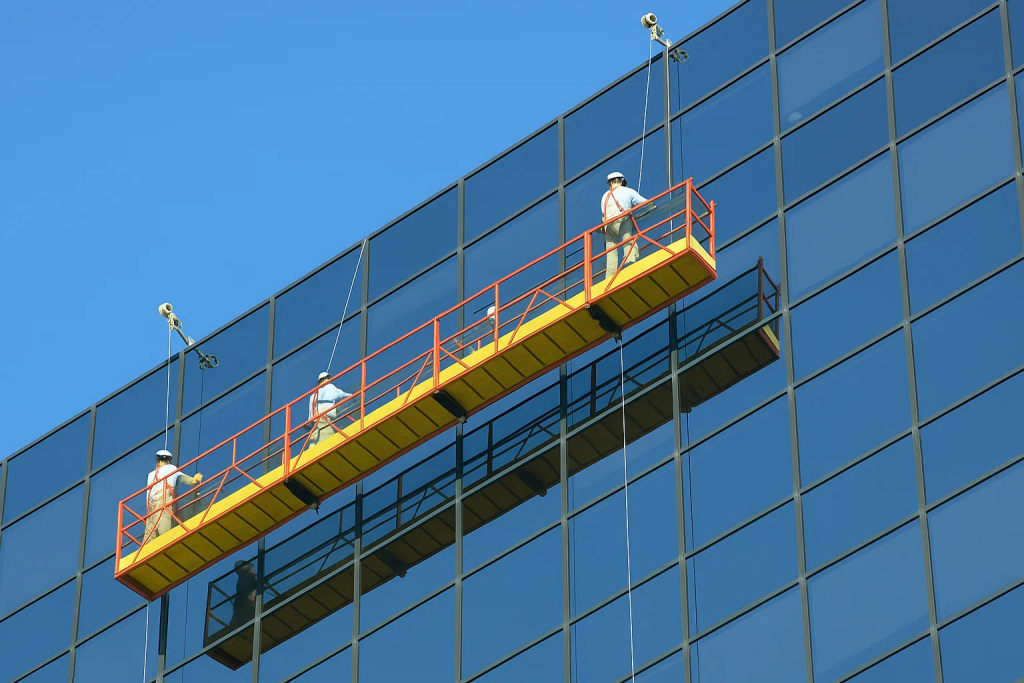
Suspended scaffolds, or swing stages, present a unique set of hazards related to overhead anchorage, ropes, and hoists.
- Anchorage and Support Systems:
- Counterweights: Only items specifically designed as counterweights may be used. Materials like sand, gravel, roofing felt, or masonry blocks are prohibited because they can be easily dislodged. Counterweights must be secured to the outrigger beams to prevent accidental displacement.
- Tiebacks: Tiebacks for outrigger beams must be secured to a structurally sound anchorage on the building. Standpipes, vents, electrical conduit, or other piping systems are not structurally sound anchorages.
- Hoist and Rope Requirements:
- Hoists: Both power-operated and manually-operated hoists must be tested and listed by a qualified testing laboratory.
- Wire Rope Inspection: A competent person must inspect ropes before each shift. Ropes must be replaced if they show signs of physical damage, kinks, corrosion, or more than six randomly distributed broken wires in one rope lay.
- Prohibited Equipment: Gasoline-powered hoists are strictly forbidden on suspension scaffolds due to fire and exhaust hazards.
Part 3: Protecting Workers: Access, Fall Protection, and Falling Objects
Once a scaffold is structurally sound, the focus shifts to protecting the workers who use it. This involves ensuring safe access, preventing falls from height, and mitigating the risk of falling objects.
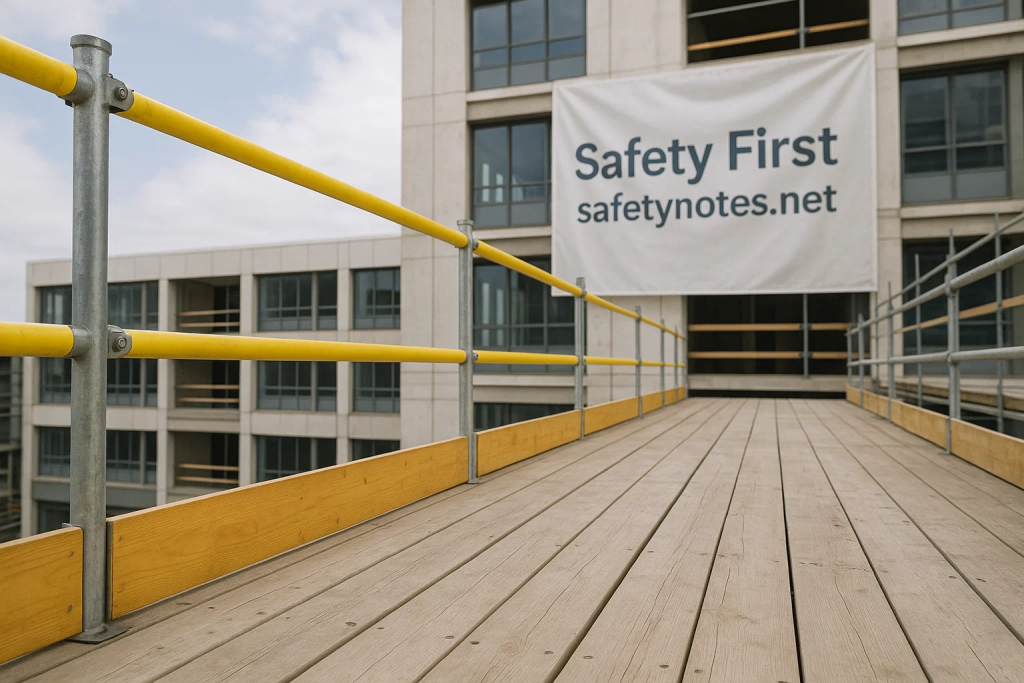
Safe Access and Egress: Getting On and Off the Scaffold (§1926.451(e))
Safe access must be provided whenever a scaffold platform is more than 2 feet above or below a point of access.
- Permissible Access Methods:
- Ladders (portable, hook-on, attachable)
- Stair towers (scaffold stairways)
- Ramps and walkways
- Integral prefabricated scaffold frames
- Prohibited Access: Using crossbraces as a means of access is strictly prohibited. Their diagonal orientation does not provide the secure footing and handholds of a proper ladder.
- Ladder and Stairway Requirements:
- Ladders must be positioned so they do not tip the scaffold and must have uniformly spaced rungs.
- Stairways must be installed between 40 and 60 degrees from the horizontal and be equipped with rest platforms and handrails.
Fall Protection: The 10-Foot Rule and Beyond (§1926.451(g))
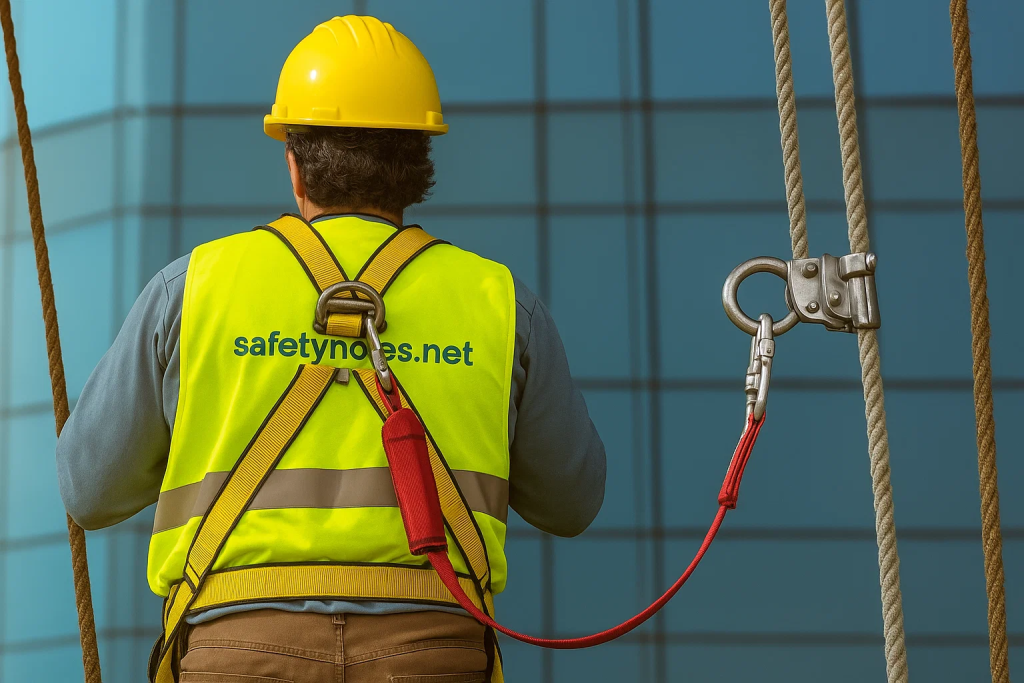
Falls are the number one killer in construction. OSHA’s fall protection rules for scaffolds are clear and non-negotiable.
- The Universal 10-Foot Trigger Height: Each employee on a scaffold more than 10 feet above a lower level shall be protected from falling to that lower level.
- Guardrail System Requirements: Guardrails are the most common form of fall protection. A standard system includes:
- Top Rail: The top edge height must be between 38 and 45 inches above the platform surface. It must be capable of withstanding a force of at least 200 pounds.
- Midrail: Installed approximately halfway between the top rail and the platform. It must withstand a force of at least 150 pounds.
- Toeboard: Required to prevent tools and materials from falling (discussed below).
- Personal Fall Arrest Systems (PFAS): A PFAS consists of an anchorage, connectors, and a full-body harness.
- Anchorage: The lanyard must be attached to a vertical lifeline, horizontal lifeline, or a structural member of the scaffold. Crucially, on a suspended scaffold, the PFAS anchor point must be independent of the ropes supporting the scaffold itself.
- Specific Requirements for Different Scaffold Types: The type of fall protection required varies by the type of scaffold.
- Two-Point Suspension Scaffolds (Swing Stages): Workers must be protected by both a guardrail system AND a personal fall arrest system. This dual system provides redundancy in case one system fails.
- Boatswains’ Chairs and Catenary Scaffolds: Workers must use a personal fall arrest system.
- Supported Scaffolds: Workers must be protected by either a guardrail system or a personal fall arrest system.
Falling Object Protection: Safeguarding Workers Below (§1926.451(h))
Workers on scaffolds are not the only ones at risk; those working below are vulnerable to falling tools, materials, and debris.
- Hard Hats: The first line of defense for every worker on site, but additional measures are required.
- Toeboards, Screens, and Canopies:
- Toeboards: Must be installed along the edge of platforms more than 10 feet high to prevent objects from being kicked off. They must be at least 3.5 inches high and securely fastened.
- Screens and Debris Nets: If materials are stacked higher than the toeboard, screens or mesh must be installed from the toeboard to the top rail.
- Canopies: Canopy structures can be erected over workers below to deflect falling objects.
- Barricading: The area below a scaffold where objects could fall must be barricaded to prohibit entry, or all workers in that area must be protected by overhead canopies.
Part 4: Specific Scaffold Types and Aerial Lifts (§1926.452 & §1926.453)
While the general requirements in §1926.451 apply broadly, §1926.452 provides additional, specific rules for different types of scaffolds.
Additional Rules for Common Scaffold Types
- Mobile Scaffolds (Rolling Towers):
- Casters and wheels must be locked with a positive wheel and/or swivel lock to prevent movement while the scaffold is in use.
- Employees may only ride on a moving scaffold if the surface is level, the height-to-base ratio is 2:1 or less, outriggers are installed, and the propelling force is applied to the base.
- Fabricated Frame Scaffolds:
- Frames and panels must be braced with cross, horizontal, or diagonal braces to secure vertical members.
- Frames must be joined vertically with coupling pins or an equivalent means.
- Pump Jack and Ladder Jack Scaffolds:
- Ladder jack scaffolds shall not exceed a height of 20 feet.
- Ladders used to support ladder jacks must be heavy-duty and placed to prevent slipping.
- Pump jack poles made of wood shall not exceed 30 feet in height.
Aerial Lifts: A Class of Their Own (§1926.453)
It is a common misconception that aerial lifts (such as boom lifts and scissor lifts) are covered by general scaffold standards. They are not. They are addressed exclusively by §1926.453.
Key operational safety rules for aerial lifts include:
- Fall Protection: A body belt or harness with a lanyard must be worn and attached to the boom or basket. Never attach a lanyard to an adjacent pole, structure, or piece of equipment.
- Operational Conduct: Employees must always stand firmly on the floor of the basket and must not sit or climb on the edge of the basket or use planks or ladders to gain extra height.
- Pre-Use Inspection: Lift controls must be tested each day before use to ensure they are in safe working condition.
- Stable Foundation: Brakes must be set, and when outriggers are used, they must be positioned on pads or a solid surface.
Part 5: The Human Element: Training and Retraining (§1926.454)
The safest scaffold design is rendered useless if the people working on it are not properly trained. §1926.454 mandates specific training for all personnel involved with scaffolds.
Mandatory Training for All Scaffold Users
Every employee who performs work while on a scaffold must be trained by a qualified person to recognize the associated hazards and understand the procedures to control or minimize them. This training must cover:
- The nature of electrical, fall, and falling object hazards in the work area.
- The correct procedures for dealing with these hazards.
- The proper use of the scaffold and the proper handling of materials on it.
- The maximum intended load and load-carrying capacities of the scaffold.
Specialized Training for Erectors and Dismantlers
Employees who erect, dismantle, move, operate, repair, maintain, or inspect scaffolds face a different set of risks. They must be trained by a competent person on:
- The nature of scaffold hazards.
- The correct procedures for erecting, dismantling, moving, operating, repairing, and inspecting the specific type of scaffold in question.
- The design criteria, maximum intended load, and intended use of the scaffold.
When is Retraining Required?
Training is not a one-time event. Retraining is required whenever the employer has reason to believe an employee lacks the necessary skill or understanding for safe work. This is triggered when:
- Changes at the worksite present a new hazard.
- Changes in the types of scaffolds, fall protection, or other equipment present a new hazard.
- Inadequacies in an employee’s work indicate a lack of proficiency.
Real-World Application: A crew that exclusively uses fabricated frame scaffolds is assigned to a new project requiring a tube and coupler system. Before beginning work, every member of that crew must be retrained by a competent person on the specific procedures and hazards associated with tube and coupler scaffolds.
Conclusion: Building a Culture of Vigilance
Scaffold safety is a system, not a single action. It begins with expert design from a qualified person, is implemented under the watchful eye of a competent person, and is sustained by the knowledge and vigilance of every trained worker. The regulations outlined in OSHA 1926 Subpart L are not arbitrary rules; they are life-saving principles written from the hard lessons of past tragedies.
For the HSE professional, the ultimate goal is to embed these principles into the site’s culture. A culture where workers feel empowered to stop work if they see a damaged plank, where supervisors instinctively check the foundation before every shift, and where safety is understood as a shared responsibility. By mastering and championing these standards, we can ensure that every scaffold is a safe passage to work at height, not a pathway to disaster.