Pressure Vessel Lockout Tagout: Lid and Vent Controls
EXECUTIVE SUMMARY & INCIDENT OVERVIEW
OSHA’s Chicago Region cited IPMF LLC d/b/a NaturPak in Janesville, Wisconsin, after two pressurized-kettle incidents 34 days apart. The first inspection opened 12 February 2026 following a vent-line clog that allowed pressure to build; the lid released steam, hot liquid, and solids onto two workers, resulting in one concussion and one later fatality. The second inspection opened 18 March 2026 after an identical release that killed two workers and hospitalized a third. Combined proposed penalties reached $364,100, including repeat citations for failure to develop and use pressure vessel lockout tagout procedures on the kettles.
Facilities operating vented or low-pressure sanitary vessels must treat fouling of relief paths and absence of residual-pressure interlocks as systemic design and energy-control deficiencies. Two identical releases on the same equipment within one month demonstrate that administrative procedures alone did not prevent re-energization or lid opening under pressure. Engineering controls that make lid operation physically impossible while pressure exists, combined with verified zero-energy isolation before any service, are required to interrupt the sequence that produced three fatalities.
REGULATORY STANDARDS & STATUTORY FRAMEWORK
- 29 CFR 1910.147(c)(1), (c)(4), (c)(7) — Statutory requirement to develop, document, and utilize machine-specific energy-control procedures and to train authorized employees before servicing equipment containing hazardous energy.
- 29 CFR 1910.151(c) — Statutory performance requirement that suitable facilities for quick drenching or flushing of the eyes and body be provided within the work area for immediate emergency use.
- 29 CFR 1910.132(d) — Statutory obligation for the employer to assess workplace hazards and select appropriate PPE on the basis of that assessment.
- 29 CFR 1910.28 / 1910.29 — Statutory guarding requirements for open-sided floors, platforms, and wall openings to protect employees from falls to lower levels or into process vessels.
- ASME BPVC Section VIII, Div. 1 (UG-125 and following) — Voluntary consensus engineering code specifying pressure-relief device sizing, set pressure, and installation; not an OSHA statutory mandate unless incorporated by reference or cited under the General Duty Clause.
- ANSI/ISEA Z358.1 — Voluntary consensus standard providing design and performance criteria for emergency eyewash and shower equipment; not codified in 29 CFR 1910.151(c).
HAZARD VS. CONTROL MATRIX
| Identified Failure / Hazard | Applicable Standard (Statutory or Consensus) | Root Cause | Mandatory Engineering / Administrative Control |
|---|---|---|---|
| Clogged vent line converting vessel to unintended pressure vessel | 29 CFR 1910.147(c)(4); ASME BPVC VIII (consensus) | No inspection, clean-out, or redundant relief path independent of single vent | Install independent relief device sized per ASME; establish written vent-integrity verification under zero-energy state |
| Lid opening under residual pressure | 29 CFR 1910.147(c)(1); 1910.212(a)(1) (guarding) | Absence of pressure-interlocked lid or trapped-key system | Engineer lid interlock that prevents opening while differential pressure exists; interlock setpoints defined by equipment PHA |
| Absence of documented LOTO for servicing | 29 CFR 1910.147(c)(4), (c)(7) (statutory repeat) | No machine-specific procedures or training for vent, agitator, or utility isolation | Develop and train on kettle-specific LOTO; verify zero-energy state by try-step before lid or vent work |
| No emergency drench capability or thermal PPE assessment | 29 CFR 1910.151(c); 1910.132(d) (statutory) | No hazard assessment performed; no plumbed drench station within work area | Complete 1910.132(d) assessment; locate suitable drench facilities so injured worker reaches them without crossing release zone |
HIERARCHY OF CONTROLS & SAFEGUARDING VS. LOTO
Administrative warnings, signs, and procedural instructions do not eliminate hazardous energy; they rely on consistent human compliance that failed repeatedly in this case. Machine safeguarding and interlocks protect operators during intended process operation by preventing lid movement while pressure is present. These devices do not substitute for full lockout/tagout because LOTO requires physical isolation of all energy sources, verification of zero energy, and application of locks and tags before any employee enters the danger zone for servicing, unclogging, or maintenance.
Engineered controls must include pressure-responsive lid interlocks, redundant relief paths independent of the process vent, differential-pressure instrumentation that permits lid operation only at verified zero differential, and double-block-and-bleed sequences on steam and utility lines. Threshold parameters, maximum allowable working pressure, and interlock setpoints are established by equipment-specific engineering limits, manufacturer documentation, and formal Process Hazard Analysis rather than generic values.
SUPERVISOR TOOLBOX TALK DISCUSSION
- Pre-Shift Line Clearances: What documented procedure verifies that relief pathways and vents are free of obstructions prior to energizing?
- Interlock Verification: Is it mechanically or electrically impossible to bypass active safeguarding while hazardous energy is present?
- Zero-Energy Verification: What physical test (bleeding, gauge reading, try-step) proves complete zero-energy state before any barrier is breached?
- Toolbox talk records: Where are the signed attendance and topic-verification documents retained for the most recent pressure vessel lockout tagout discussion?
PRACTICAL SHIFT INSPECTION CHECKLIST
- Confirm all vent and relief-path inspection tags are current and that any scheduled clean-out was performed under documented zero-energy conditions.
- Visually verify that lid interlock sensors and pressure switches remain securely mounted and free of process residue; do not actuate under live conditions.
- Inspect LOTO stations for presence of required locks, hasps, and tags specific to each kettle; replace any missing devices before shift start.
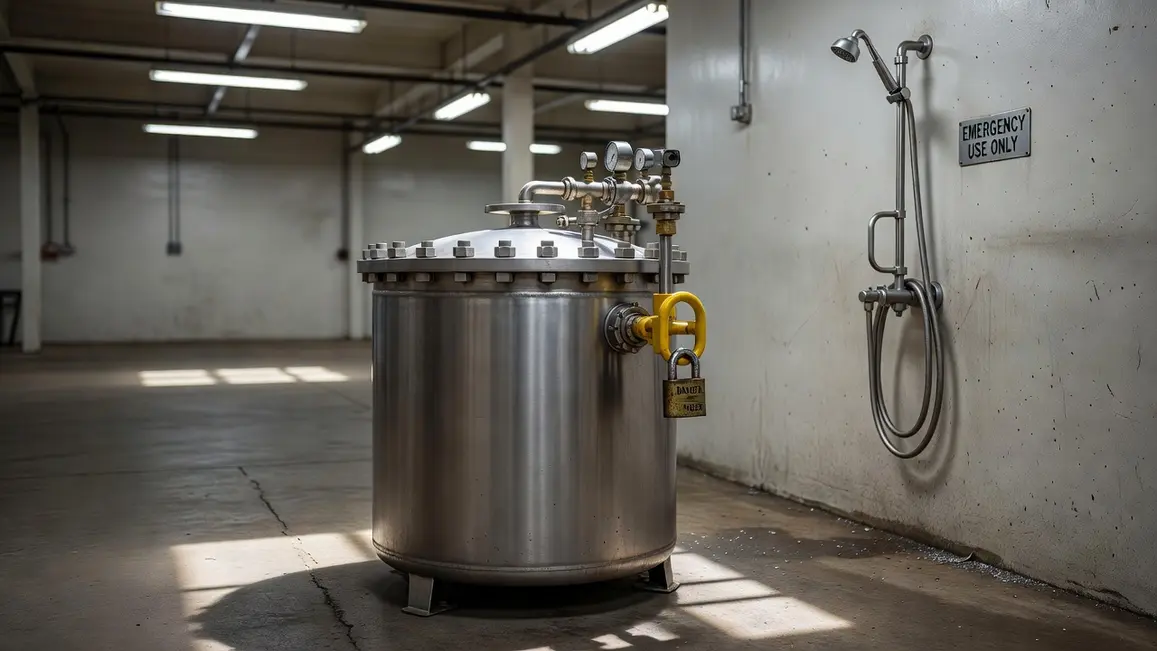
- Walk the path from each kettle workstation to the nearest drench station to confirm unobstructed access and legible directional signage.
- Review the most recent 1910.132(d) thermal-hazard assessment to ensure selected PPE remains appropriate for current process media.
Source & Reference: This technical analysis reviews public safety notices and regulatory reports for educational and hazard prevention purposes. Read the original report.