Meeting details
Topic: Meat grinder safety and hazardous-energy control
Goal: This toolbox talk on meat grinder safety will review the January 29, 2026 amputation at the Piggly Wiggly supermarket in Bowden, Georgia, and prevent similar accidents in 2026.
The incident: what happened?
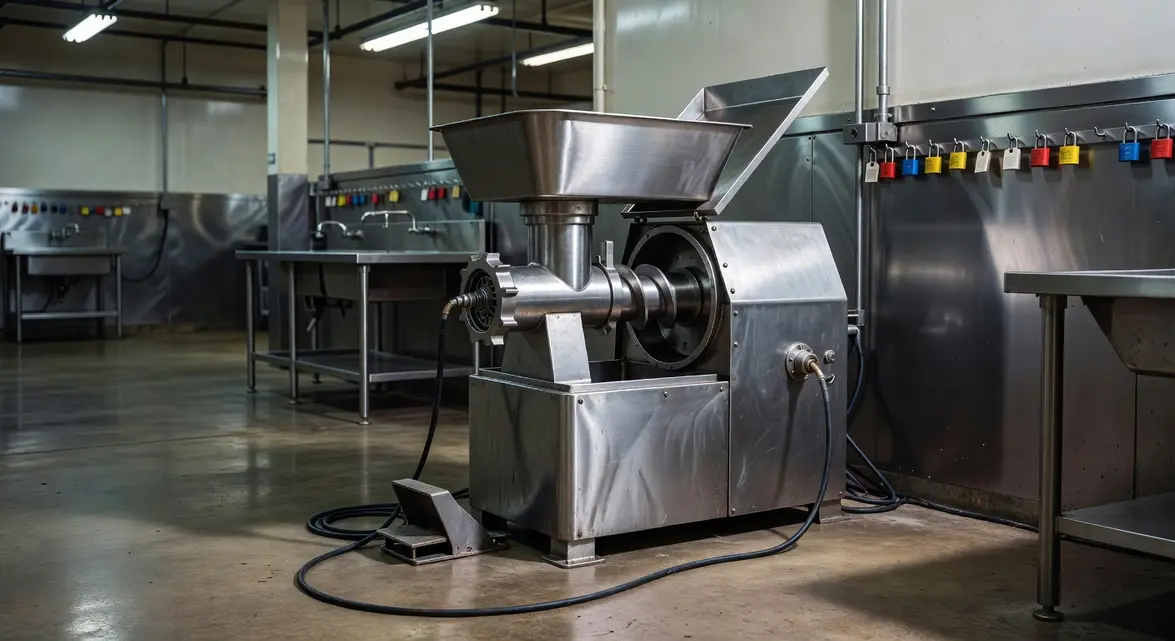
On January 29, 2026, a meat-department employee at the Piggly Wiggly supermarket operated by RBG Foods Inc. in Bowden, Georgia, was seriously injured while cleaning a commercial meat grinder. A co-worker inadvertently stepped on the grinder’s foot-control pedal, causing the machine to start and pull the worker’s hand into the rotating auger. The resulting injury was the amputation of four fingers. OSHA’s inspection found that the employer had bypassed or removed the machine’s safety guards, exposing workers to moving parts and flying debris. The agency issued one willful citation for the deliberate bypass of machine guarding, one serious citation for the absence of a hazardous-energy-control (lockout/tagout) program, and one other-than-serious citation for failing to report the amputation within the required 24-hour window, proposing penalties totaling $196,251.
The root causes centered on the removal of manufacturer-installed guards and the complete lack of any lockout/tagout procedures for the foot-pedal-controlled equipment. These failures allowed unexpected energization during cleaning, directly leading to the severe injury. Proper meat grinder safety practices were not in place, turning a routine cleaning task into a life-altering event.
Core safety lesson
The Hazard: Unguarded or bypassed mechanical moving parts combined with unexpected energization via foot-pedal control during cleaning.
The Control: Maintain all manufacturer guards in place and functional while enforcing a complete hazardous-energy-control (lockout/tagout) program that isolates every energy source before any employee places hands or tools inside the machine.
These controls are non-negotiable because the rotating auger of a commercial meat grinder can amputate fingers in a fraction of a second once power is applied. Bypassing guards removes the last physical barrier between the worker and the danger zone, while the absence of lockout/tagout leaves the foot pedal able to energize the machine at any moment. Daily pre-use inspections and a written SOP that requires verification of zero-energy state eliminate both the physical and procedural gaps that allowed this incident to occur.
Meat grinder safety depends on consistent enforcement of these measures. When guards are disabled or lockout procedures are ignored, the probability of catastrophic injury rises sharply, as demonstrated by the $196,251 in proposed OSHA penalties and the permanent harm suffered by the employee. Supervisors must treat every cleaning or maintenance task as a controlled operation that never begins until all energy sources are isolated and verified.
Supervisor’s discussion guide
Q1: “Looking at our own equipment today, where is the biggest risk of unexpected energization via foot-pedal control?”
Q2: “Have any of our meat grinders or similar machines had guards removed or bypassed recently, and what immediate action would you take if you found one?”
Q3: “How would you verify that a machine is in a zero-energy state before beginning a cleaning task on this equipment?”
Q4: “What steps in our current meat grinder safety procedures need reinforcement to prevent a repeat of the 2026 Bowden incident?”
Action plan & inspection
- Verify that all manufacturer-installed guards on every meat grinder are present, functional, and not bypassed.
- Confirm a written lockout/tagout program exists and that personal locks and tags are available for all affected employees.
- Inspect foot-pedal controls to ensure they cannot be activated unintentionally during cleaning or maintenance.
- Review training records to confirm every worker who cleans or services grinders has completed hazardous-energy-control training within the past year.
- Establish a daily pre-use inspection checklist that must be completed and signed before any grinder is placed back into service.
Key takeaways
Meat grinder safety requires that guards remain intact and that lockout/tagout procedures are followed without exception before any hand enters the danger zone. The 2026 Bowden incident shows that bypassing guards and omitting energy isolation can result in permanent injury and substantial regulatory penalties within a single moment of inattention.
Supervisors must lead by verifying compliance at every shift and treating any deviation from these controls as an immediate stop-work situation. Consistent application of these practices protects workers and ensures regulatory compliance across all meat-processing equipment.
Source & Disclaimer: This toolbox talk is for educational purposes based on public report. Read Original Report