Meeting details
Date: March 03, 2026
Topic: Hopper Malfunction Fire at General Mills Cereal Plant
Goal: This toolbox talk on hopper malfunction fire will review the recent incident at the General Mills factory in Buffalo, New York, and equip supervisors with strategies to prevent similar accidents in 2026.
The incident: what happened?
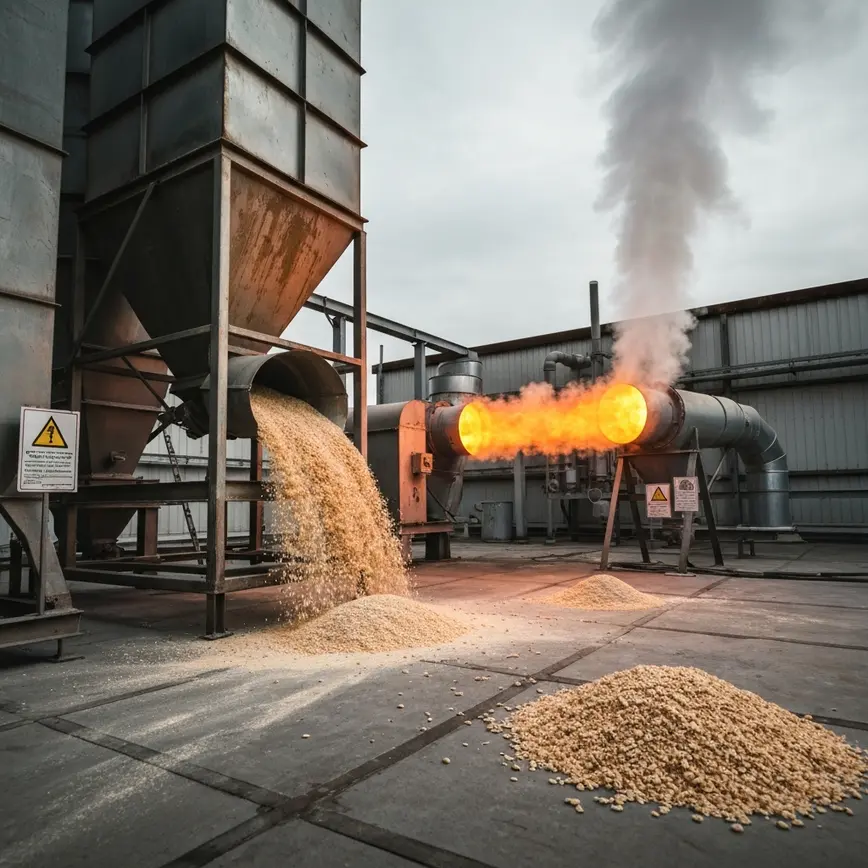
On March 2, 2026, around 9:30 a.m., a hopper malfunction fire broke out at the General Mills cereal plant in Buffalo, New York. The incident stemmed from a malfunction in a hopper unit that unexpectedly deposited Lucky Charms cereal ingredients onto the roof of the 10-story building. These combustible materials accumulated in a vulnerable area adjacent to a hot exhaust unit, which ignited the dry ingredients, sparking the fire. This hopper malfunction fire was swiftly contained but highlighted critical vulnerabilities in equipment operation and material handling.
The fire was limited to a 6×6-foot section of the east side roof and was extinguished within minutes thanks to the rapid response from the Buffalo Fire Department, led by Battalion Chief Sean Eagen, in cooperation with plant personnel. Damage was estimated at $10,000, and fortunately, there were no injuries reported, with all employees confirmed safe. Incident stabilization efforts followed immediately, underscoring the importance of quick containment in industrial settings prone to such rapid escalations.
Core safety lesson
The technical failure in this hopper malfunction fire centered on the hopper unit’s uncontrolled discharge of combustible cereal ingredients onto the roof, where they encountered a nearby hot exhaust unit. This sequence exposed multiple interconnected hazards: equipment malfunction allowing materials into unauthorized zones, proximity of ignition sources to potential accumulation areas, and the inherent risks of combustible dust buildup from dry ingredients.
The Hazard: Hopper malfunction leading to uncontrolled combustible material discharge near heat sources, compounded by combustible dust accumulation on elevated surfaces like roofs.
The Control: Regular preventive maintenance schedules, condition-based monitoring with sensors for hopper alignment and function, automated shutdown interlocks, physical barriers or separation between heat sources and material paths, temperature monitoring alarms, dust collection systems like pneumatic conveying with filters, and routine roof inspections with housekeeping protocols.
These controls are non-negotiable because a single hopper malfunction fire can escalate from a minor spill to a structure-threatening blaze in seconds, as seen in the General Mills case where minutes made the difference between minor damage and catastrophe. Preventive maintenance and monitoring detect anomalies early, preventing malfunctions that bypass normal safeguards. Barriers and dust controls eliminate ignition opportunities, ensuring that even if a failure occurs, the risk of fire propagation is minimized—critical in multi-story facilities where access and evacuation challenges amplify consequences.
Supervisor’s discussion guide
Engage your crew with these targeted questions to drive home the lessons from the hopper malfunction fire:
Q1: “Looking at our own equipment today, where is the biggest risk of hopper malfunction or similar material discharge?”
Q2: “How close are our hot exhaust units or other ignition sources to material handling areas, and what barriers do we have in place?”
Q3: “What does our current maintenance schedule look like for hoppers and dust-prone equipment, and how can we improve monitoring?”
Q4: “If we found combustible buildup on our roofs or elevated areas, what’s our immediate housekeeping and inspection protocol?”
Action plan & inspection
Conduct these 5 immediate checks post-meeting to mitigate hopper malfunction fire risks:
- Inspect all hopper units for alignment, function, and sensor integrity; test automated shutdown interlocks.
- Verify physical separation or barriers between hot exhaust units and material discharge paths; measure distances if needed.
- Examine roofs and elevated surfaces for combustible dust or material accumulation; perform housekeeping if any is found.
- Review and update preventive maintenance schedules for material handling equipment, including condition-based monitoring systems.
- Test temperature monitoring alarms and dust collection systems (e.g., filters in pneumatic conveying) for operational readiness.
Key takeaways
The General Mills hopper malfunction fire serves as a stark reminder that equipment failures like hopper malfunctions can deposit combustible materials into ignition-prone areas, leading to rapid fires even in controlled industrial environments. Key to prevention is layering controls: rigorous maintenance, real-time monitoring, physical separations, and proactive housekeeping to address combustible dust hazards before they ignite.
Supervisors must lead by enforcing these measures daily, fostering a culture where every team member reports anomalies immediately. By prioritizing these steps, we ensure our sites avoid the $10,000 damage and near-miss outcomes of this incident, safeguarding personnel and operations in 2026 and beyond.
Source & Disclaimer: This toolbox talk is for educational purposes based on public report. Read Original Report