Meeting details
Topic: Heavy equipment loading safety at quarry sites
Goal: This toolbox talk on heavy equipment loading will review the fatal incident at Riverstone Quarry and prevent similar accidents in 2026.
Date: July 02, 2026
Duration: 10 minutes
Facilitator: Site Supervisor
The incident: what happened?
On Friday, June 26, 2026, just before 7 a.m., a worker at the Riverstone Quarry in New Liberty, Iowa, was fatally injured during heavy equipment loading operations. A large wheel loader being loaded onto a trailer suddenly shifted and fell, pinning the worker underneath. The Scott County Sheriff’s Office and the Mine Safety and Health Administration (MSHA) immediately launched a joint investigation into the event at the location on New Liberty Road.
Multiple agencies responded to the scene, including Scott County Medic EMS, New Liberty Fire, the Scott Emergency Communications Center, and the Scott County Medical Examiner’s Office. The worker died from injuries sustained when the machinery shifted without warning. This tragedy underscores the critical need for rigorous controls during every phase of heavy equipment loading.
Core safety lesson
The Hazard: Unsecured or unstable heavy equipment during transport loading combined with workers positioned under shifting loads.
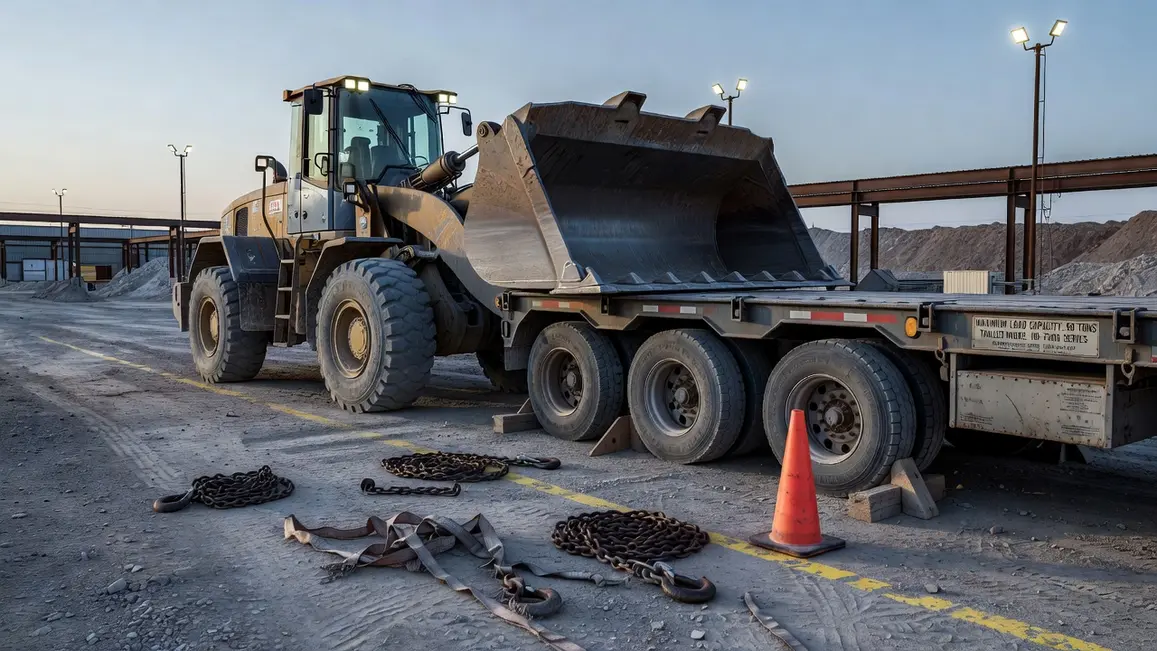
The Control: Establish exclusion zones, use wheel chocks or blocking, verify trailer capacity and level ground, and require a written lift plan reviewed by a competent person before any heavy equipment loading begins.
During heavy equipment loading, even a momentary loss of stability can cause catastrophic movement. The Riverstone Quarry incident demonstrates how a wheel loader can shift without visible warning if it is not fully secured or if the trailer is not properly prepared. Relying on visual checks alone is insufficient because weight distribution can change rapidly once the machine begins to move onto the trailer.
Enforcing a written plan and physical blocking is non-negotiable because it removes the possibility of human error under time pressure. Exclusion zones keep personnel outside the fall radius, while rated straps and chocks provide mechanical certainty that the load will remain stable until fully secured. These layered controls directly address the root causes identified in the investigation and must be applied without exception on every site.
Supervisor’s discussion guide
Q1: “Looking at our own equipment today, where is the biggest risk of unstable loads during heavy equipment loading?”
Q2: “What specific steps do we currently take to verify trailer capacity and ground level before moving machinery?”
Q3: “How do we ensure that no one enters the potential fall zone while equipment is being positioned on a trailer?”
Q4: “If a competent person is unavailable to review the securing plan, what is our immediate protocol?”
Action plan & inspection
- Confirm wheel chocks and blocking materials are staged at every loading area before any heavy equipment loading begins.
- Verify that trailer load capacity ratings are posted and matched to the equipment weight on site.
- Mark and enforce a visible exclusion zone around the trailer during all loading activities.
- Require a written lift/secure plan signed by a competent person for every heavy equipment loading operation today.
- Inspect all slings, chains, and straps for current load ratings and damage before use.
Key takeaways
Heavy equipment loading demands mechanical certainty through chocks, blocking, and rated securing devices rather than reliance on positioning or visual judgment. The June 26 incident at Riverstone Quarry shows that a single uncontrolled shift can produce fatal results when these controls are absent.
Supervisors must treat every loading operation as a planned lift that requires documented review and strict exclusion zones. Consistent application of these controls will prevent recurrence and protect every crew member on the site.
Source & Disclaimer: This toolbox talk is for educational purposes based on public report. Read Original Report