Meeting details
Topic: Preventing forklift work at height incidents on construction and refurbishment sites
Goal: This toolbox talk on forklift work at height will review the South East Refurbishment Limited incident and prevent similar accidents in 2026.
The incident: what happened?
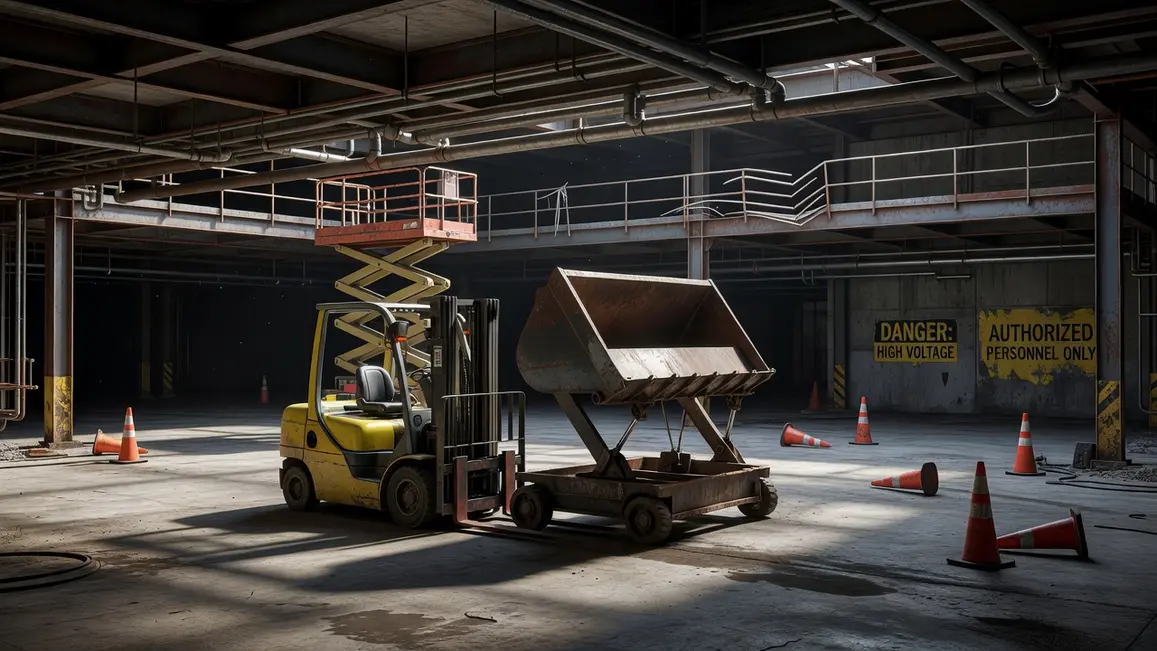
On 28 March 2023 at the EMIR site on Wotton Road, Ashford, Kent, a 41-year-old contractor named Aaron Back fell from a tipping bucket mounted on a forklift while dismantling pipework. The company had ordered a scissor lift, but it proved too tall for the work area, leading to the improvised use of the forklift-and-bucket arrangement. No suitable contractor-management arrangements, training, instruction, or supervision were in place. South East Refurbishment Limited was later fined £90,000 plus £27,241 costs after an HSE investigation revealed the company had received prior HSE advice and enforcement action on the same issues since 2013. This case highlights the extreme dangers of forklift work at height when proper controls are absent.
Mr Back sustained life-changing injuries, including loss of function on his left side and chronic back pain. He described the incident as having “destroyed” him and given him a “lifetime sentence.” The immediate cause was the worker falling from the unsecured bucket to the concrete floor. Systemic failures included the complete absence of risk assessment or a safe system of work for the improvised access method, no training or authorisation for forklift or scissor-lift use, and inadequate contractor oversight despite previous regulatory intervention.
Core safety lesson
The Hazard: Uncontrolled work at height using an improvised, non-compliant access platform (forklift tipping bucket).
The Control: Ensure work at height is properly planned; select suitable access equipment (e.g., scissor lift or mobile elevating work platform) that fits the space, and prohibit use of forklift-mounted buckets unless they are specifically designed, certified, and risk-assessed for personnel lifting.
This control is non-negotiable because forklift tipping buckets are not engineered or certified for carrying people. Any deviation from certified equipment introduces uncontrolled variables such as instability, lack of guardrails, and sudden movement that can instantly result in catastrophic falls. The 2023 incident demonstrates how quickly an apparently convenient workaround becomes a life-altering event when these standards are ignored.
Repeated HSE enforcement since 2013 shows that organisations which fail to close known gaps continue to expose workers to the same hazards. Proper planning and equipment selection eliminate the temptation to improvise and ensure that only verified, fit-for-purpose solutions are used. When forklift work at height is required, only purpose-built attachments with full certification and documented risk assessment may be considered; anything less places both the operative and the organisation in breach of legal duties.
Supervisor’s discussion guide
Q1: “Looking at our own equipment today, where is the biggest risk of an improvised access method being used instead of proper work-at-height equipment?”
Q2: “How do we currently verify that subcontractors are trained and authorised before they begin any elevated tasks?”
Q3: “What steps would we take on this site if a scissor lift proved too tall for the available headroom?”
Q4: “Where might we see pressure to shortcut the safe system of work for forklift work at height, and how do we push back on that pressure?”
Action plan & inspection
- Confirm that all current method statements explicitly prohibit the use of forklift tipping buckets for personnel access.
- Verify training records and authorisations for every operative and subcontractor who may operate or work from mobile elevating work platforms.
- Inspect all work-at-height equipment on site to ensure it is certified, suitable for the space, and accompanied by current LOLER thorough examination certificates.
- Review contractor pre-qualification documentation and on-site monitoring logs to confirm robust oversight arrangements are active.
- Check that any previous HSE improvement notices or advice have been fully actioned and that evidence of closure is available for inspection.
Key takeaways
Forklift work at height must never be performed using improvised or uncertified arrangements. The 2023 incident at the EMIR site resulted directly from the substitution of a tipping bucket for proper access equipment, combined with absent training, supervision, and contractor controls. Every supervisor must treat any suggestion of using a forklift for personnel lifting as an immediate stop-work trigger until a compliant alternative is secured.
Robust planning, verified competence, and active contractor management are the only defences against these foreseeable failures. By applying the lessons from this case, sites can ensure that no worker suffers the same permanent injuries and lifelong consequences that Aaron Back continues to endure.
Source & Disclaimer: This toolbox talk is for educational purposes based on public report. Read Original Report