Meeting details
Topic: Falling Object Toolbox Talk – Unsecured Equipment at Height
Goal: This toolbox talk on falling object toolbox talk will review the Emma Bridgewater incident and prevent similar accidents in 2026.
The incident: what happened?
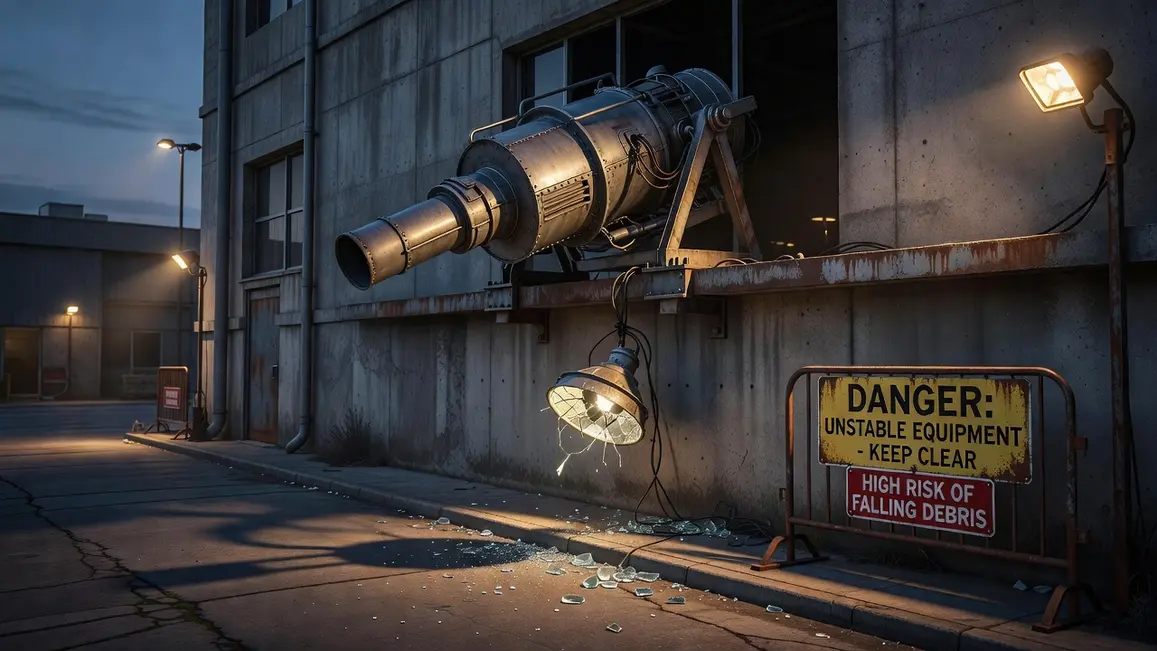
On 23 November 2024 at the Emma Bridgewater gift shop in Hanley, Stoke-on-Trent, an unsecured artificial snow machine positioned in a window opening above the shop fell during a public Christmas lights switch-on event. The machine struck a light fixture on the way down, propelling a shard of broken glass into the head of a 12-year-old girl and causing a deep laceration that required hospital treatment. This falling object toolbox talk examines how the absence of proper securing methods turned routine event equipment into a serious projectile above a crowded public area.
The Health and Safety Executive investigation found that Emma Bridgewater Ltd had failed to assess the risks of the installation and had not followed the manufacturer’s instructions for securing the machine. The company breached Regulation 10(1) of the Work at Height Regulations 2005 and Section 3(1) of the Health and Safety at Work etc. Act 1974. On 6 July 2026 the firm was fined £266,666 plus £4,931 costs and a £2,000 victim surcharge at Birmingham Magistrates’ Court.
Core safety lesson
The Hazard: Unsecured equipment or materials at height above a public area.
The Control: Conduct a specific risk assessment for any item placed above occupied spaces and implement a secure fixing method (e.g., rated brackets, safety chains, or secondary restraints) that is inspected before each use.
Any object installed above people must be treated as a potential falling object. When secondary restraints are omitted, even a relatively light machine can generate enough momentum to shatter fixtures and create high-velocity fragments. The Emma Bridgewater case demonstrates that a single unsecured item can convert a festive public event into a serious injury incident within seconds.
Manufacturer instructions exist to eliminate precisely these failure modes. Ignoring them removes the engineered safety margin that keeps equipment stable under vibration, wind, or accidental contact. Because the public cannot be expected to recognise or avoid overhead hazards, the only reliable protection is physical restraint that has been verified before any exposure occurs.
Supervisor’s discussion guide
Q1: “Looking at our own equipment today, where is the biggest risk of unsecured equipment or materials at height above a public area?”
Q2: “Have we reviewed the manufacturer’s instructions for every temporary installation we plan to mount above occupied spaces?”
Q3: “What secondary restraint methods are available on site, and when were they last inspected?”
Q4: “How would we adapt our falling object toolbox talk procedures if we were preparing a similar public event next week?”
Action plan & inspection
- Identify every item currently installed above any occupied area and confirm it has a documented risk assessment.
- Verify that each elevated item is fitted with rated secondary restraints in addition to its primary fixing.
- Check that manufacturer installation instructions are on file and that the current installation matches those instructions exactly.
- Complete a pre-use inspection checklist signed by a competent person before any public or workforce access beneath the equipment.
- Establish an exclusion zone beneath any elevated equipment until all securing measures have been confirmed and recorded.
Key takeaways
Every item placed at height must be risk-assessed, secured according to manufacturer guidance, and inspected before use. The Emma Bridgewater prosecution shows that failing to apply these controls can result in life-changing injury to members of the public and substantial financial penalties for the responsible organisation.
Supervisors must treat falling object toolbox talk sessions as the moment to verify that no similar exposure exists on their own sites. Consistent application of risk assessment, secondary restraint, and documented sign-off removes the conditions that allowed this incident to occur.
Source & Disclaimer: This toolbox talk is for educational purposes based on public report. Read Original Report