Meeting details
Date: March 18, 2026
Topic: Energized Line Safety During Pole Replacement
Goal: This toolbox talk on energized line safety will review the Primoris T&D Services LLC electrocution fatality and prevent similar accidents in 2026.
The incident: what happened?
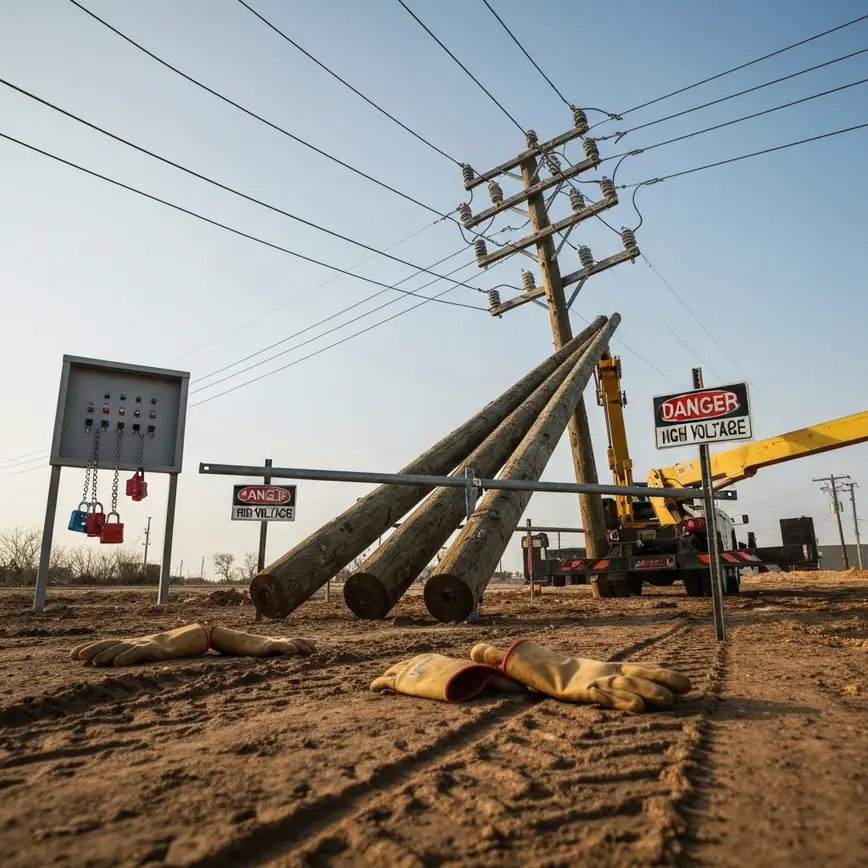
In August prior to the March 18, 2026 publication, a work crew from Primoris Services Corp., operating as Primoris T&D Services LLC—a Florida utility construction contractor for Duke Energy—was replacing a utility pole at a Seminole site. During the operation, the pole contacted an energized overhead transmission line, leading to a fatal electrocution of one lineman and hospitalization of two other workers. This incident underscores the critical importance of energized line safety protocols when working near live power infrastructure, as the direct contact with the energized line caused immediate and severe electrical hazards.
OSHA’s investigation revealed three serious violations: (1) failure to maintain minimum approach distance from energized parts or deenergize the line; (2) no designated observer to monitor distances and warn workers; and (3) the job briefing did not cover special precautions for working near energized transmission lines. As a result, OSHA proposed $49,650 in penalties, which the employer contested before the Occupational Safety and Health Review Commission. These lapses in energized line safety directly contributed to the tragedy, highlighting how procedural oversights can turn routine pole replacements into life-threatening events.
Core safety lesson
The technical failures in this incident revolved around inadequate adherence to OSHA standards for working near energized transmission lines, specifically during pole replacement activities where proximity risks are extremely high.
The Hazard: Contact with energized overhead transmission lines during pole replacement, lack of a designated observer for proximity monitoring, and inadequate pre-job briefings on energized line risks.
The Control: Deenergize transmission lines before work or ensure strict adherence to minimum approach distances per OSHA 29 CFR 1910.269 using insulated tools and barriers; assign a qualified designated observer per OSHA 1910.333(c)(4) trained to monitor distances, issue immediate verbal warnings, and stop work; conduct comprehensive job briefings per OSHA 1910.269(c) covering site-specific hazards, precautions, and emergency procedures, documented and attended by all crew members.
These controls are non-negotiable because energized lines carry lethal voltages that can arc across distances, causing instant electrocution without direct touch—minimum approach distances account for this arc flash potential, and skipping deenergization assumes perfect execution under fatigue or wind conditions, which is unrealistic. Without a dedicated observer, crews lose real-time vigilance, as split-second drifts into the prohibited zone occurred here. Comprehensive briefings embed these protocols into muscle memory, addressing the root cause of 80% of such incidents per industry data; neglecting them invites complacency, turning preventable hazards into fatalities.
Implementing energized line safety controls rigorously not only complies with OSHA but saves lives by creating layered defenses—deenergization as primary, distances and observers as backups, and briefings as the foundation. In 2026, with increasing grid modernization projects, supervisors must enforce these without exception to avoid contestable fines and irreversible losses.
Supervisor’s discussion guide
Engage the crew with these questions to reinforce energized line safety:
Q1: “Looking at our own equipment today, where is the biggest risk of contact with energized overhead transmission lines?”
Q2: “What would you do if you saw a crew member approaching too close to an energized line during pole work?”
Q3: “How can we ensure our job briefings always cover energized line safety precautions?”
Q4: “Who on this crew is qualified to act as a designated observer, and what training do they need?”
Action plan & inspection
- Inspect all upcoming job sites for overhead energized transmission lines within 10 feet of work zones and flag them immediately.
- Verify that every crew member has current training certification for OSHA 1910.269 minimum approach distances and insulated tool use.
- Assign and document a qualified designated observer for all pole replacement or lifting operations near energized lines.
- Review and update the last 5 job briefing forms to confirm inclusion of energized line safety precautions and site-specific hazards.
- Conduct a mock observer drill: simulate pole lift near a marked hazard zone and practice verbal warnings and work stoppage.
Key takeaways
Key to energized line safety is treating every proximity hazard as a zero-tolerance zone: deenergize when possible, maintain distances religiously, deploy observers without fail, and brief comprehensively every time. The Primoris incident proves that skipping any layer—whether observer, briefing, or distance—creates a fatal chain reaction, as seen with one death and two hospitalizations from a single pole contact.
In 2026, commit to these OSHA-mandated controls as your unbreakable standard. Document everything, train relentlessly, and stop work at the first sign of doubt. Energized line safety isn’t optional—it’s the line between going home and becoming a statistic.
Source & Disclaimer: This toolbox talk is for educational purposes based on public report. Read Original Report