Meeting details
Topic: Dust Exposure Toolbox Talk – Lessons from the Puratos Limited Prosecution
Date: July 20, 2026
Duration: 10 minutes
Goal: This toolbox talk on dust exposure toolbox talk will review the Puratos Limited bakery prosecution and prevent similar accidents in 2026.
The incident: what happened?
On 3 December 2024, the Health and Safety Executive inspected Puratos Limited’s bakery in Buckingham and found workers exposed to inhalable dust concentrations above workplace exposure limits. The same visit identified repeated manual handling of 25 kg ingredient sacks. A follow-up dust-monitoring report on 18 December 2024 confirmed the over-exposure. The company had already received enforcement action for identical dust and manual-handling failings during a 2021 inspection. On 17 July 2026, Puratos pleaded guilty to breaching Section 2(1) of the Health and Safety at Work etc. Act 1974 and was fined £120,000 plus £6,270 costs at Milton Keynes Magistrates’ Court. This dust exposure toolbox talk uses the case to drive immediate improvements.
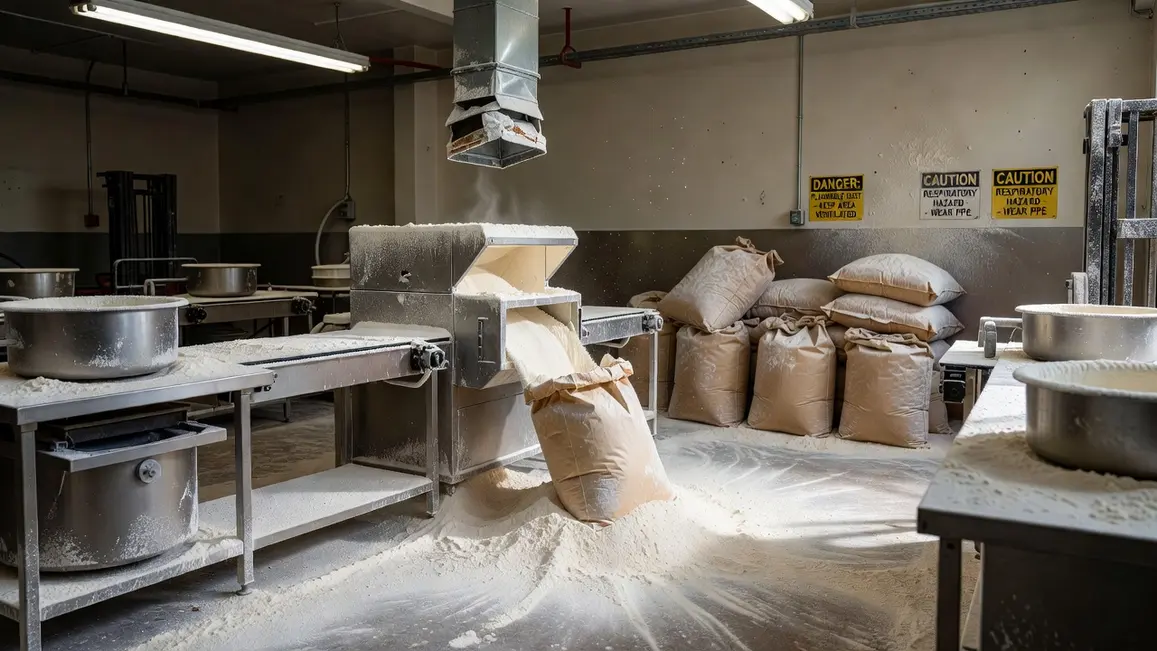
The root causes were clear: failure to enclose dust-generating processes, absence of effective local exhaust ventilation, continued use of compressed air and dry sweeping, and reliance on manual handling without mechanical aids. Despite prior enforcement, the company had not implemented a corrective-action tracking system. The result was sustained worker exposure to hazardous dust and ergonomic risks that could have been eliminated years earlier.
Core safety lesson
The Hazard: Inhalable flour and ingredient dust combined with repeated manual handling of 25 kg sacks.
The Control: Enclose dust sources, install and maintain local exhaust ventilation, prohibit compressed air and dry sweeping, replace manual sack handling with mechanical aids, and maintain a documented corrective-action tracking system verified by internal audits.
These controls are non-negotiable because dust exposure above workplace limits causes irreversible respiratory disease. When processes are not enclosed and LEV is absent or poorly maintained, fine particles remain airborne and are inhaled throughout the shift. Dry sweeping and compressed air simply redistribute the hazard, increasing both inhalation risk and the potential for secondary explosions.
Repeated manual handling of 25 kg sacks compounds the problem by creating cumulative musculoskeletal injury. Without mechanical aids and task-specific risk assessments, workers face preventable strains and long-term disability. The 2021 enforcement action proved that verbal reminders are insufficient; only a formal tracking system with assigned responsibilities, deadlines, and audit verification ensures prior failures are not repeated.
Supervisor’s discussion guide
Q1: “Looking at our own equipment today, where is the biggest risk of dust exposure?”
Q2: “Which tasks still require manual lifting of 25 kg sacks, and what mechanical aids could replace them?”
Q3: “How do we currently record and close out actions from previous inspections or audits?”
Q4: “What improvements should we add to our next dust exposure toolbox talk to keep these lessons fresh?”
Action plan & inspection
- Verify that all dust-generating points are fully enclosed or fitted with operational LEV.
- Confirm that compressed air and dry sweeping are prohibited and that suitable vacuum or wet-cleaning equipment is available and used.
- Inspect all manual-handling tasks involving 25 kg sacks and ensure mechanical aids or automated systems are in place.
- Review the corrective-action tracking system to confirm 2021 and 2024 findings are logged with responsible persons and completion dates.
- Schedule an internal audit within 14 days to verify that all controls remain effective and documented.
Key takeaways
Effective control of inhalable dust requires engineering solutions, not reliance on worker behaviour. Enclosure, local exhaust ventilation, and prohibition of dry cleaning methods must be maintained and inspected regularly. Manual handling must be eliminated through mechanical aids, and every previous enforcement action must be tracked to completion through a formal system.
Recidivism carries heavy financial and legal consequences, as shown by the £120,000 fine. Supervisors must treat dust exposure toolbox talk sessions as opportunities to verify that controls are working, not simply as compliance exercises. Immediate action after this meeting protects workers and prevents the company from repeating the failures that led to prosecution.
Source & Disclaimer: This toolbox talk is for educational purposes based on public report. Read Original Report