Meeting details
Date: March 17, 2026
Topic: Preventing Continuous Miner Pinning Incidents
Goal: This toolbox talk on continuous miner pinning will review the worker fatality at Deer Run Mine and prevent similar accidents in 2026.
The incident: what happened?
On March 5, 2026, at 1:20 p.m., a tragic continuous miner pinning incident occurred at the Deer Run Mine, an underground coal mine in Hillsboro, Illinois. A 32-year-old continuous mining machine operator named Jessie E. Smith from Godfrey, IL, was fatally pinned against the coal rib by the continuous mining machine he was operating. Despite having over six years of experience, including more than four years at this mine, Smith was working for Patton Mining, a subsidiary of Foresight Energy Labor, LLC, when the uncontrolled machine movement led to this crushing hazard.
The incident was confirmed as work-related by Montgomery County Coroner Randy Leetham and reported to the Mine Safety & Health Administration (MSHA). This event underscores the deadly risks in confined underground spaces where even seasoned operators can face sudden loss of machine control, resulting in rib-contact pinning without adequate safeguards.
Core safety lesson
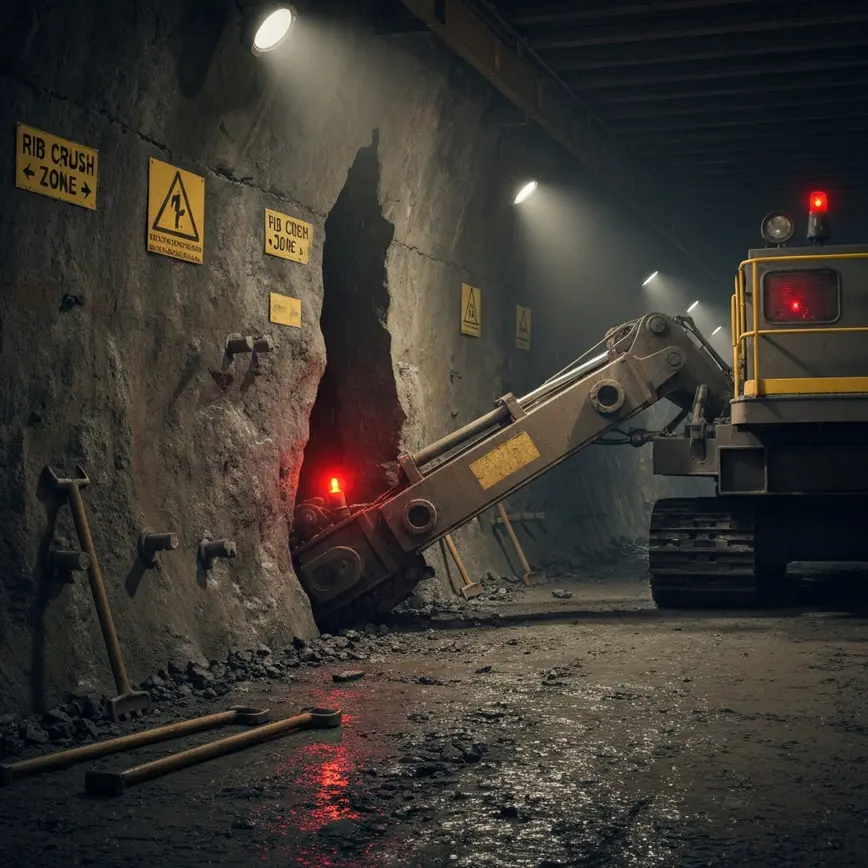
The technical failure in this continuous miner pinning incident stemmed from uncontrolled machine movement during tram operations, allowing the continuous mining machine to pin the operator against the coal rib. Root causes included potential lapses in proximity detection, inadequate remote operation enforcement, and insufficient real-time hazard awareness in tight underground environments.
The Hazard: Uncontrolled tram or machine movement leading to pinning/crushing against coal ribs in confined spaces.
The Control: MSHA-approved proximity detection systems that automatically halt machine movement when personnel enter hazardous zones; mandatory remote-control operation with fail-safe interlocks; and task-specific training with pre-task risk assessments.
These controls are non-negotiable because underground coal mining involves narrow, unstable ribs where split-second machine shifts can trap operators irreversibly—proximity systems provide an electronic barrier that experience alone cannot match, as proven by this fatality despite the victim’s six years on the job. Remote operation keeps personnel out of the danger zone entirely, enforcing MSHA standards that have reduced similar incidents by integrating fail-safes like automatic stops. Finally, rigorous training and assessments build layered defenses, ensuring every shift anticipates continuous miner pinning risks through spotters and monitoring, turning potential tragedies into preventable near-misses.
Supervisor’s discussion guide
Engage your crew with these four targeted questions to drive home the lessons from this continuous miner pinning incident:
Q1: “Looking at our own equipment today, where is the biggest risk of continuous miner pinning against the ribs?”
Q2: “How does our proximity detection system function, and what happens if it fails during tram?”
Q3: “When operating in tight spaces, what remote control protocols must we always follow?”
Q4: “Share one pre-task risk assessment step that could have prevented this incident on our site.”
Action plan & inspection
Immediately after this meeting, conduct these five critical checks on all continuous mining equipment and procedures:
- Inspect proximity detection systems for proper installation, battery life, and functionality—test auto-stop within 5 feet of simulated zones.
- Verify remote-control units and fail-safe interlocks prevent tram without operator clearance per MSHA standards.
- Review machine guarding around tram mechanisms and rib-contact areas for damage or gaps.
- Confirm all crew have current task-specific training records for continuous miner operations, including rib-pinning scenarios.
- Perform a site walkthrough for pre-task risk assessments, marking high-risk rib areas with signage and spotter assignments.
Key takeaways
Continuous miner pinning remains a lethal hazard in underground coal mines, as evidenced by the Deer Run Mine fatality, where even experienced operators face crushing risks from uncontrolled machine movement. Prioritizing proximity detection, remote operation, and rigorous training creates unbreakable defenses—never rely on experience alone when technology and protocols can eliminate the danger zone.
Commit to these controls daily: inspect systems religiously, enforce remote ops in confined spaces, and integrate hazard recognition into every task. By acting on this toolbox talk today, we honor Jessie E. Smith and ensure no similar continuous miner pinning tragedies occur on our sites in 2026 or beyond.
Source & Disclaimer: This toolbox talk is for educational purposes based on public report. Read Original Report