Meeting details
Topic: Confined space excavator safety briefing for site supervisors
Goal: This toolbox talk on confined space excavator safety will review the fatal incident involving a mini-excavator at Converse Elementary School and prevent similar accidents in 2026.
The incident: what happened?
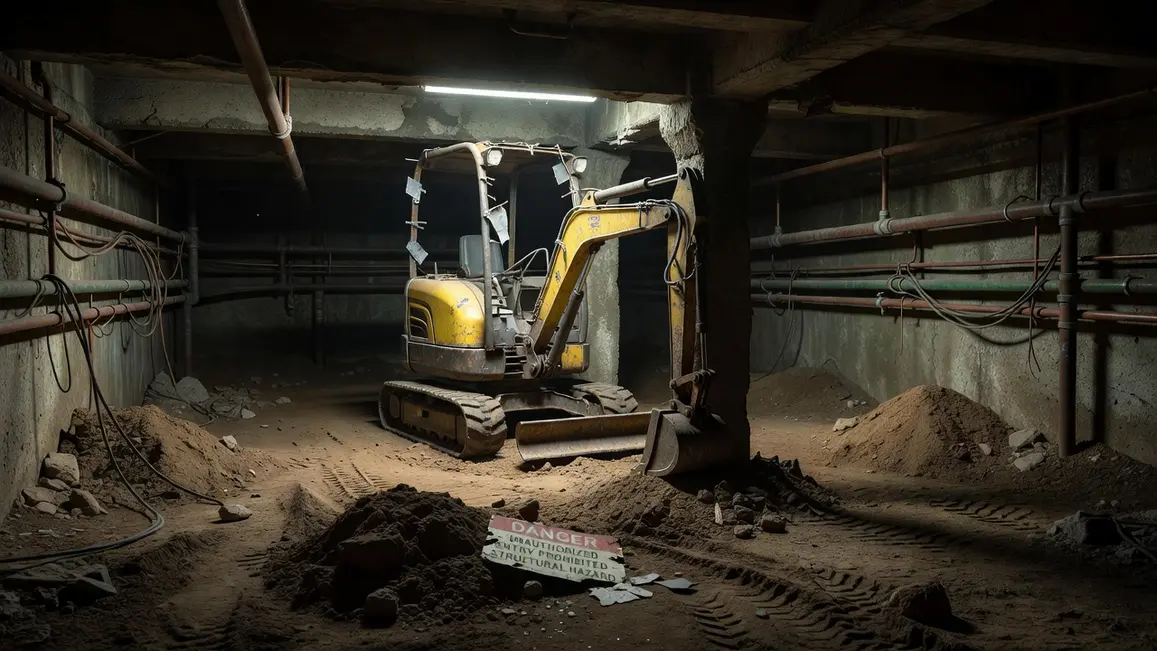
On January 7, 2026, a worker employed by D L Bandy Constructors Inc. and supplied through Pacesetters Personnel Services was fatally injured while operating a mini-excavator inside the crawl space of Converse Elementary School in Converse, Texas. The worker became trapped between the equipment and a concrete beam while removing accumulated dirt. This tragic event underscores the critical importance of confined space excavator safety when powered mobile equipment must operate in restricted underground areas. OSHA’s investigation determined that the contractor had removed the rollover protective structures from the mini-excavators and installed fabricated parts to allow the machines to fit in the confined area.
The agency issued one willful violation and 15 serious violations to D L Bandy Constructors Inc. with proposed penalties of $276,399, along with two serious violations to Pacesetters Personnel Services carrying proposed penalties of $23,170. The immediate cause was the worker becoming trapped between the modified equipment and a concrete beam. The investigating authority was OSHA’s Dallas Region. No confined-space entry permit, atmospheric testing, or rescue plan was in place, and both permanent and temporary workers lacked adequate training on the combined hazards of confined spaces and altered mobile equipment.
Core safety lesson
The Hazard: Removal or modification of manufacturer-installed safety devices (rollover protective structures) to fit equipment into a restricted space.
The Control: Prohibit any alteration of safety equipment; select or use only equipment that can safely operate within the space without compromising protective features, or perform the work by alternative methods.
Altering factory-installed rollover protective structures eliminates the last line of defense against crushing injuries in low-clearance environments. When these devices are removed or replaced with makeshift parts, the machine can physically enter the space but loses its ability to protect the operator during any tip-over or sudden movement. In the Converse Elementary School crawl space, this modification directly contributed to the worker becoming pinned against a concrete beam.
Confined space excavator safety demands that equipment be chosen or configured to preserve every original safety feature. Relying on fabricated adaptations signals that the chosen method is fundamentally incompatible with the space. Supervisors must treat any request to modify protective structures as an immediate stop-work trigger and explore alternative excavation techniques such as hand tools, vacuum excavation, or remote-controlled equipment that does not require structural changes.
Supervisor’s discussion guide
Q1: “Looking at our own equipment today, where is the biggest risk of equipment modification to fit a tight area?”
Q2: “Have we performed a confined-space evaluation and issued an entry permit for every underground or crawl-space task scheduled this week?”
Q3: “What specific training records do we have on file for both permanent employees and temporary workers regarding confined space excavator safety?”
Q4: “If an excavator cannot enter a space without removing its rollover protective structure, what alternative methods should we consider before work begins?”
Action plan & inspection
- Verify that no mini-excavator or similar equipment on site has had its rollover protective structure removed or altered.
- Confirm a written confined-space entry permit exists and is signed for every crawl space or underground excavation task.
- Review training documentation for all workers, including temporary staff supplied by staffing agencies, covering both confined-space hazards and equipment-specific operation.
- Inspect atmospheric testing equipment and rescue retrieval systems to ensure they are staged and functional before any entry.
- Designate and document a competent person responsible for overseeing both confined-space entry and mobile equipment use on the current project.
Key takeaways
Confined space excavator safety requires strict adherence to manufacturer equipment configurations and formal entry procedures. Removing safety devices to force equipment into a space eliminates critical protection and violates OSHA standards, as demonstrated by the willful and serious citations issued after the January 7, 2026 incident.
Supervisors must enforce equipment selection criteria that preserve all protective features, ensure every worker receives documented training, and require permits, testing, and rescue plans before any confined-space work begins. These controls are non-negotiable because they directly address the root causes that led to a preventable fatality beneath Converse Elementary School.
Source & Disclaimer: This toolbox talk is for educational purposes based on public report. Read Original Report