Meeting details
Date: March 07, 2026
Topic: Cherry Picker Powerline Safety
Goal: This toolbox talk on cherry picker powerline safety will review the fatal electrocution at the Willand Biogas site in Devon and prevent similar accidents in 2026.
The incident: what happened?
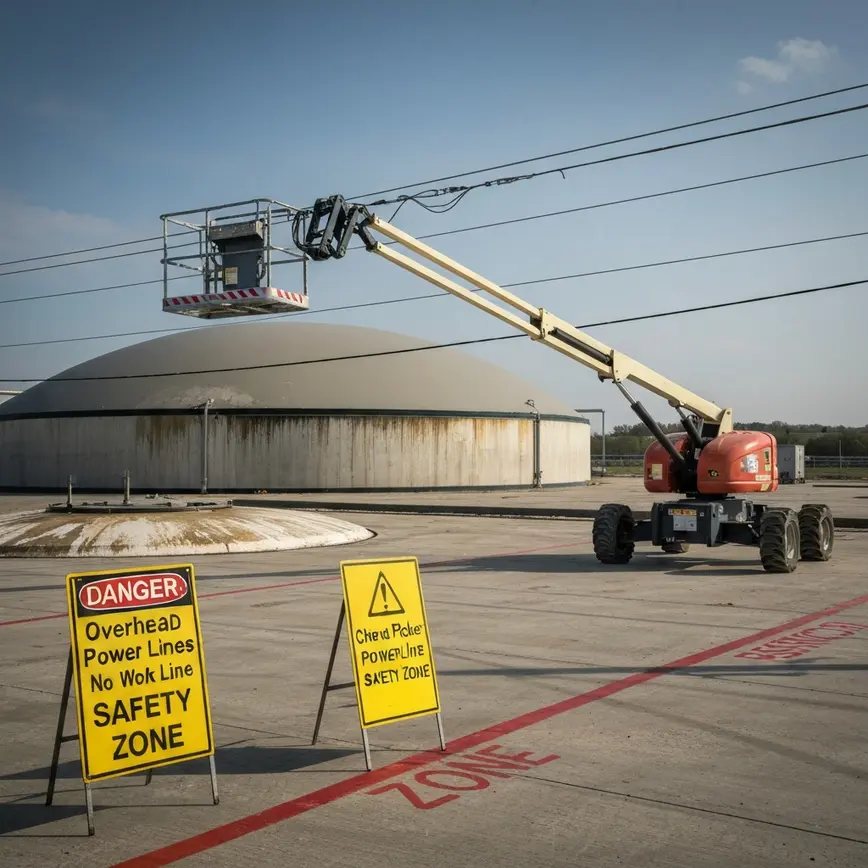
On 1 June 2020, at the Willand Biogas site on Hide Market Road, Cullompton, Devon, cherry picker powerline safety was tragically overlooked, leading to a catastrophic accident. Carl Parsons, 34, a father of three, was fatally electrocuted, and his colleague Luke Madavan suffered life-changing injuries when a cherry picker operated by New Wave Marine Ltd—contracted by Willand O&M Ltd—struck an 11,000-volt overhead powerline. The workers were using the cherry picker to lift the lid of a biodigester to stir a crust blockage, but electrical current arced through the metal basket, delivering lethal shocks.
An HSE investigation revealed multiple failures: Willand O&M had ignored advice from their principal contractor and Western Power Distribution nine months earlier to relocate the powerline, and no adequate controls were implemented, such as height restrictors, restricted zones, or proper supervision. New Wave Marine’s risk assessment was inadequate, lacking formal training and supervision for operators. As a result, Willand O&M was fined £51,000 plus £28,467 costs for breaching Electricity at Work Regulations 1989, while New Wave Marine faced £30,000 plus £8,000 costs for violations of Management of Health and Safety at Work Regulations 1999 and Work at Height Regulations 2005.
Core safety lesson
The technical failure stemmed from operating a mobile elevating work platform directly under or too close to overhead powerlines without mitigation, allowing the cherry picker’s boom to make contact and arc electricity. This incident underscores the deadly risks of overhead powerline contact by mobile elevating work platform (cherry picker), where even non-contact proximity can cause arcing, as seen with the 11,000-volt line.
The Hazard: Overhead powerline contact by mobile elevating work platform (cherry picker): Electrical current arced through the metal basket, causing electrocution and severe shock.
The Control: Relocate or bury powerlines in coordination with the electricity network provider, as advised by HSE guidance (e.g., AIS8) and Look Out Look Up industry standards. Additional controls include thorough, site-specific risk assessments per Management of Health and Safety at Work Regulations 1999, planning work to avoid proximity or implement goalpost barriers/height limiters; competent supervision, mandatory training on overhead powerline risks, and site inductions with clear restricted zones, per Work at Height Regulations 2005 and Electricity at Work Regulations 1989.
Cherry picker powerline safety is non-negotiable because powerlines carry lethal voltages that can arc several meters, bypassing physical contact—11,000 volts in this case proved instantly fatal. Ignoring prior warnings, as Willand O&M did, compounds risks in dynamic sites like biogas plants where equipment like cherry pickers must maneuver unpredictably. Proper planning and controls prevent unplanned operations, ensuring supervisors enforce no-go zones and verify training, saving lives and avoiding hefty fines.
Supervisor’s discussion guide
Engage the crew with these questions to reinforce cherry picker powerline safety:
Q1: “Looking at our own equipment today, where is the biggest risk of overhead powerline contact by cherry picker?”
Q2: “What steps should we take if we spot overhead lines near our work zone before starting any elevated task?”
Q3: “How can inadequate risk assessments lead to incidents like the one at Willand Biogas—share examples from our site.”
Q4: “Recall your training on cherry picker powerline safety: What must you do if supervision is absent during setup?”
Action plan & inspection
- Identify and map all overhead powerlines within 20 meters of cherry picker operating zones using site surveys and utility locator services.
- Review and update site-specific risk assessments for all work at height tasks near powerlines, confirming goalpost barriers or height limiters are in place.
- Inspect cherry pickers for height restrictors, daily pre-use checks, and ensure operators’ training certificates are current and on file.
- Establish and mark restricted zones with signage under all powerlines, verifying compliance during site inductions.
- Contact electricity providers immediately for any relocation needs and document coordination in the site safety plan.
Key takeaways
Cherry picker powerline safety demands proactive measures: always prioritize relocation of lines when feasible, conduct rigorous risk assessments, and enforce training and supervision. The Willand Biogas tragedy shows that ignoring warnings and skipping controls leads to irreversible consequences—fatal electrocution and life-altering injuries from a preventable arc flash.
Commit to these standards today: no work near powerlines without barriers, no untrained operators in cherry pickers, and zero tolerance for complacency. By embedding these lessons, we protect our teams in 2026 and beyond, honoring regulations like Electricity at Work Regulations 1989 and upholding our duty of care.
Source & Disclaimer: This toolbox talk is for educational purposes based on public report. Read Original Report