Meeting details
Topic: Preventing Ammunition Plant Explosion Incidents
Goal: This toolbox talk on ammunition plant explosion will review the KNDS Ammo Italy incident and prevent similar accidents in 2026.
The incident: what happened?
On Thursday, 18 August 2026, early afternoon, an ammunition plant explosion occurred at the KNDS Ammo Italy facility in Colleferro near Rome. The event began with a fire in the powder-pressing department that triggered a blast involving medium- and large-caliber ammunition and solid propellants. The detonation produced a visible mushroom cloud, registered as an earthquake by local residents, and required response from 10 fire crews supported by a helicopter. All 24 on-site workers were accounted for with no injuries reported, though the blast remained confined to a single production and storage area and caused limited vegetation fire spread.
The incident highlights how ignition of energetic materials during powder pressing can rapidly escalate when controls fail to isolate the event. Physical separation between zones proved insufficient to fully contain secondary effects, underscoring the need for robust engineering and procedural barriers at every ammunition manufacturing site.
Core safety lesson
The Hazard: Accidental ignition of energetic materials during powder pressing.
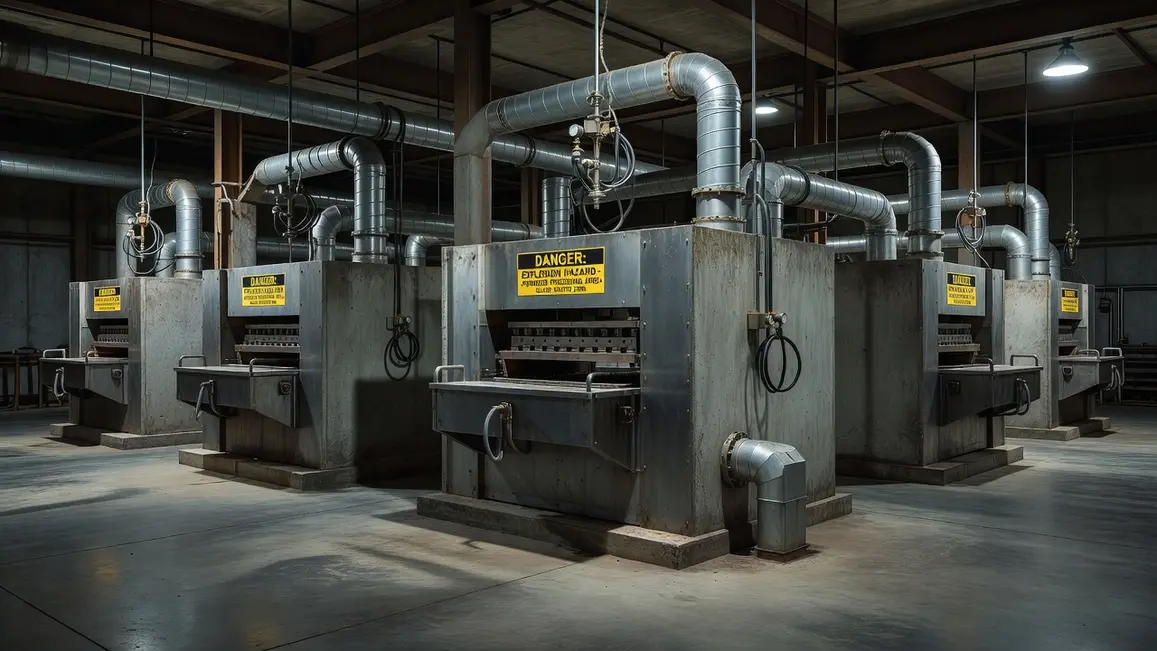
The Control: Install localized, explosion-isolated pressing cells equipped with automatic fire-suppression systems and interlocked ventilation that isolates each cell from the rest of the building.
This control is non-negotiable because energetic materials can ignite from friction, static, or equipment malfunction with almost no warning. Once initiated, the energy release is so rapid that only immediate, localized suppression can prevent transition to detonation. Without isolated cells and automatic systems, a single ignition point can propagate through shared ventilation or open floor space, turning a minor event into a facility-wide catastrophe.
Engineering isolation also protects adjacent operations and personnel by limiting blast overpressure and fragment projection. Regular testing of interlocks and suppression equipment ensures the system functions when needed, rather than relying on human intervention that may arrive too late. In the Colleferro case, the absence of such layered protection allowed the fire to reach critical mass before external responders could intervene.
Supervisor’s discussion guide
Q1: “Looking at our own equipment today, where is the biggest risk of accidental ignition of energetic materials during powder pressing?”
Q2: “How do our current ventilation and suppression systems compare to the isolated-cell design described?”
Q3: “What quantity-distance and blast-wall requirements apply to our powder-pressing operations?”
Q4: “If an ammunition plant explosion occurred here, what immediate steps would contain fire spread beyond the building?”
Action plan & inspection
- Verify that all powder-pressing cells have functional automatic fire-suppression systems and tested interlocks.
- Confirm physical separation distances and blast walls meet quantity-distance standards for the quantities in use.
- Inspect perimeter for minimum 50 m vegetation-free defensible space and clear signage.
- Review emergency drill records with local fire services and schedule any overdue joint exercises.
- Document and correct any deficiencies found during the post-meeting walk-through before resuming powder-pressing operations.
Key takeaways
Every ammunition plant explosion begins with an ignition that could have been isolated. Implementing explosion-isolated cells, automatic suppression, and strict quantity-distance siting prevents small events from becoming major incidents and protects both workers and surrounding communities.
Supervisors must treat these controls as mandatory daily requirements rather than optional enhancements. Consistent inspection, maintenance, and crew awareness are the only reliable defenses against the rapid escalation seen in the Colleferro event.
Source & Disclaimer: This toolbox talk is for educational purposes based on public report. Read Original Report