Meeting details
Topic: Excavation Safety Toolbox Talk: Lessons from a Fatal Fall
Goal: This toolbox talk on excavation safety toolbox talk will review the drowning of a 35-year-old labourer in an unprotected, water-filled excavation and prevent similar accidents in 2026.
The incident: what happened?
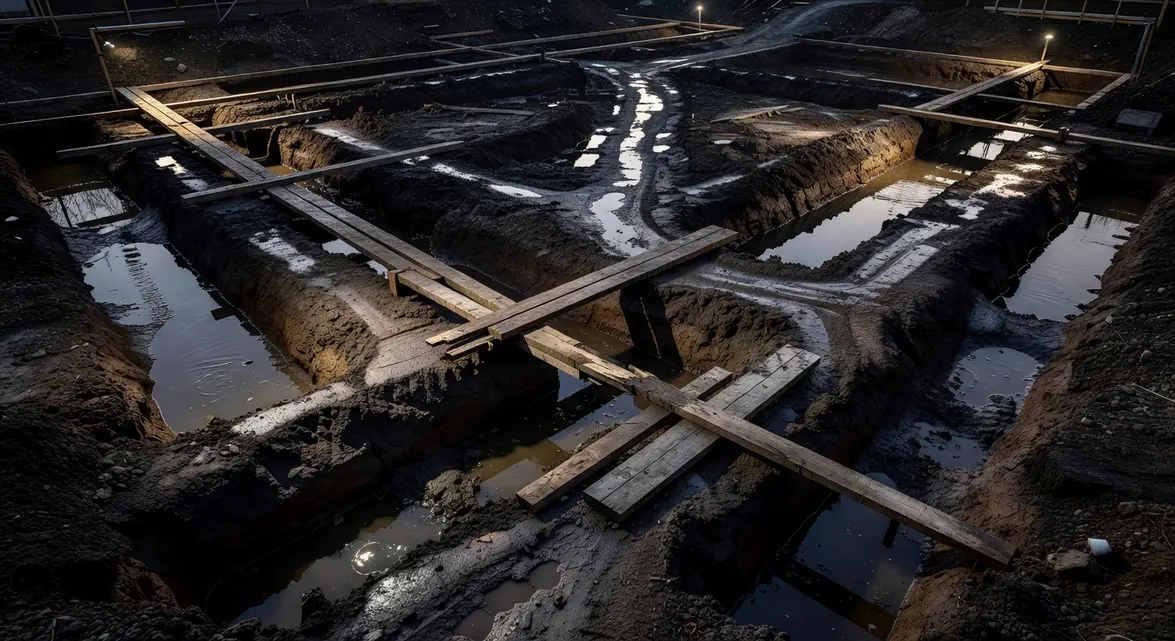
On 22 October 2021 at a residential flat development on High Street, Bovingdon, Hertfordshire, 35-year-old labourer Mykhalio Hustei drowned after falling into an open, rainwater-filled excavation while returning home at night. The site operated by Alchemist DB Limited featured multiple unprotected foundation trenches criss-crossing the area with no designated safe walkways. Temporary boards and planks used as bridges were unsecured, slippery when wet, and lacked handrails, while the entire site had no lighting. This excavation safety toolbox talk draws directly from the HSE investigation that found these conditions persisted until after the fatality.
HSE inspectors later enforced immediate improvements, including the installation of a scaffolding framework for walkways. The company was fined £20,000 plus £5,000 costs for breaching Regulation 22(2) of the CDM Regulations 2015. The root causes included complete absence of edge protection, safe pedestrian routes, and adequate temporary bridging across the excavations.
Core safety lesson
The Hazard: Unprotected open excavations combined with inadequate temporary walkways and poor site lighting.
The Control: Install substantial fixed barriers or covers around all excavations, provide properly designed secured non-slip walkways with handrails, and ensure adequate temporary lighting along all pedestrian routes, with inspections before each shift and after adverse weather.
These controls are non-negotiable because an excavation becomes a concealed hazard the moment it is left open without barriers, especially when filled with rainwater. The absence of secure, slip-resistant bridging turns any attempt to cross into a high-risk activity that can end in a fall with fatal consequences, as demonstrated when unsecured planks failed under wet conditions.
Lighting failures compound the danger by removing visual cues that would otherwise alert workers or visitors to the presence of trenches. Regulation 22(2) of the CDM Regulations 2015 exists precisely to eliminate these combined failures before access is permitted, making proactive installation and daily verification essential on every site.
Supervisor’s discussion guide
Q1: “Looking at our own equipment today, where is the biggest risk of unprotected open excavations?”
Q2: “How do we currently secure temporary bridging materials after rainfall, and what improvements are needed?”
Q3: “Where on this site would excavation safety toolbox talk principles require immediate installation of fixed barriers or covers?”
Q4: “What inspection steps must occur before the next shift to confirm all walkways remain safe and lit?”
Action plan & inspection
- Verify that every open excavation has substantial fixed barriers or covers installed before any access is allowed.
- Inspect all temporary walkways for secure fixings, non-slip surfaces, and handrails, replacing any defective materials immediately.
- Confirm adequate temporary lighting is operational along every pedestrian route across the site.
- Document pre-shift and post-weather inspections of all excavations and bridging in the site log.
- Ensure no work or access proceeds until HSE excavation guidance requirements are fully met and signed off.
Key takeaways
Every excavation must be treated as a potential fatality hazard until protected by fixed barriers, secure walkways, and proper lighting. The 2021 incident proves that unsecured planks and absent edge protection turn routine site movement into a lethal risk, especially at night or after rain.
Supervisors must enforce these controls daily without exception. Consistent application of excavation safety toolbox talk standards protects every person on site and ensures compliance with CDM Regulations 2015.
Source & Disclaimer: This toolbox talk is for educational purposes based on public report. Read Original Report