Meeting details
Topic: Lockout tagout toolbox talk on commercial meat processing equipment
Goal: This toolbox talk on lockout tagout toolbox talk will review the January 29, 2026 amputation at the Bowden Piggly Wiggly meat department and prevent similar accidents in 2026.
The incident: what happened?
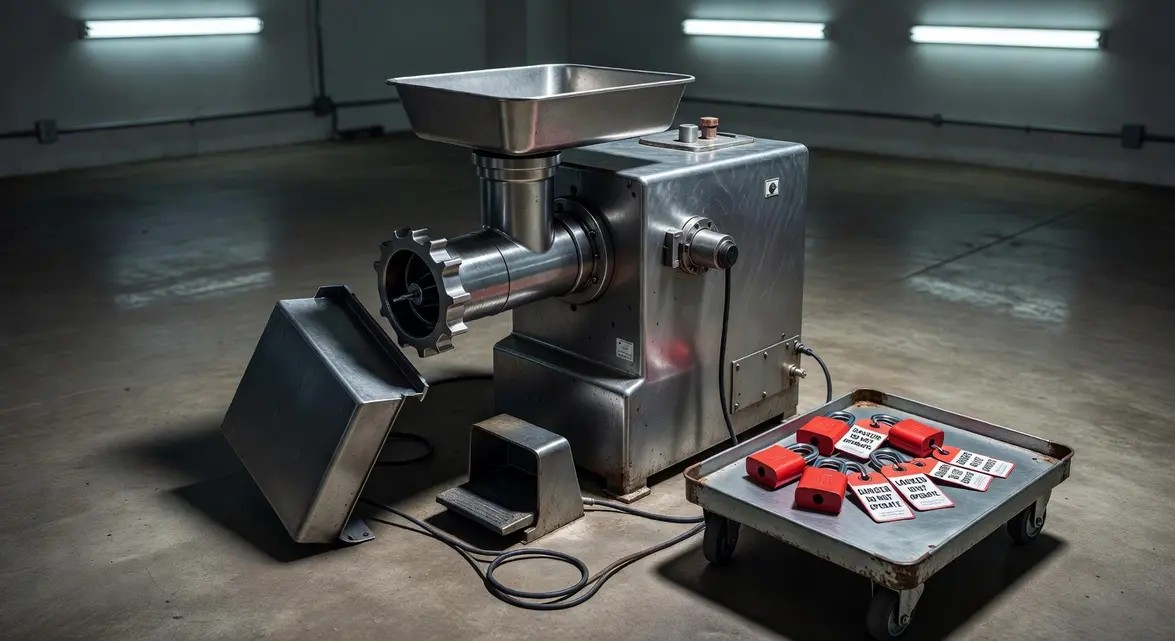
On January 29, 2026, a meat-department employee at RBG Foods Inc. operating as Piggly Wiggly in Bowden was assigned to clean a commercial meat grinder. While the worker’s hand was inside the machine, a co-worker inadvertently stepped on the grinder’s foot-control pedal, energizing the auger and amputating four of the employee’s fingers. This lockout tagout toolbox talk uses the event to underscore why energy isolation must never be skipped during cleaning tasks.
OSHA’s inspection found that the machine’s safety guards had been bypassed, that no hazardous-energy-control program was in place, and that the employer failed to report the amputation within the required 24-hour window. The violations resulted in one willful, one serious, and one other-than-serious citation with $196,251 in proposed penalties. The immediate cause was foot-pedal activation while the hand remained in the danger zone.
Core safety lesson
The Hazard: Unexpected energization of rotating auger blades due to bypassed guards and absent lockout/tagout procedures.
The Control: A written lockout/tagout program that requires authorized employees to isolate power, apply locks and tags, and verify zero-energy state before any cleaning or maintenance.
Without a formal lockout/tagout program, workers have no reliable method to prevent inadvertent machine startup. The foot-pedal control remained fully accessible, allowing accidental activation even while a hand was inside the grinder. Bypassing manufacturer guards removed the last physical barrier between the employee and the moving auger.
These controls are non-negotiable because the consequences are immediate and permanent. Amputations cannot be reversed, and OSHA citations plus six-figure penalties follow every failure to implement required energy-control measures. A single lockout tagout toolbox talk cannot replace daily enforcement, yet it establishes the expectation that every cleaning task begins with verified isolation.
Supervisor’s discussion guide
Q1: “Looking at our own equipment today, where is the biggest risk of unexpected energization?”
Q2: “Which machines in our department still have accessible foot-pedal controls that could be stepped on accidentally?”
Q3: “How do we currently verify that a machine has reached a zero-energy state before cleaning begins?”
Q4: “During this lockout tagout toolbox talk, what additional steps should we add to our daily pre-task checks?”
Action plan & inspection
- Confirm every commercial grinder has all manufacturer guards installed and functional with no evidence of bypass or modification.
- Verify a written lockout/tagout procedure exists for each piece of equipment that requires cleaning or maintenance.
- Inspect foot-pedal controls and either relocate them or install physical guards to prevent inadvertent activation.
- Ensure lockout devices, tags, and hasps are available in sufficient quantity and in good condition at each workstation.
- Confirm that all supervisors know the 24-hour OSHA reporting requirement for amputations and other severe injuries.
Key takeaways
Every cleaning task on energized equipment carries the risk of amputation when guards are bypassed and energy-isolation procedures are missing. The Bowden incident demonstrates that a single foot-pedal step can produce lifelong injury and substantial regulatory penalties when basic lockout/tagout requirements are ignored.
Supervisors must treat the lockout tagout toolbox talk as the starting point for daily enforcement. Verifying zero-energy state, protecting controls from accidental activation, and refusing to operate equipment with defeated guards are the only reliable ways to keep hands out of moving machinery in 2026 and beyond.
Source & Disclaimer: This toolbox talk is for educational purposes based on public report. Read Original Report