Meeting details
Topic: Managing Front End Loader Blind Spots on Active Sites
Goal: This toolbox talk on front end loader blind spots will review the fatal incident involving a contract driver at the Preferred Materials Inc. asphalt plant and prevent similar accidents in 2026.
The incident: what happened?
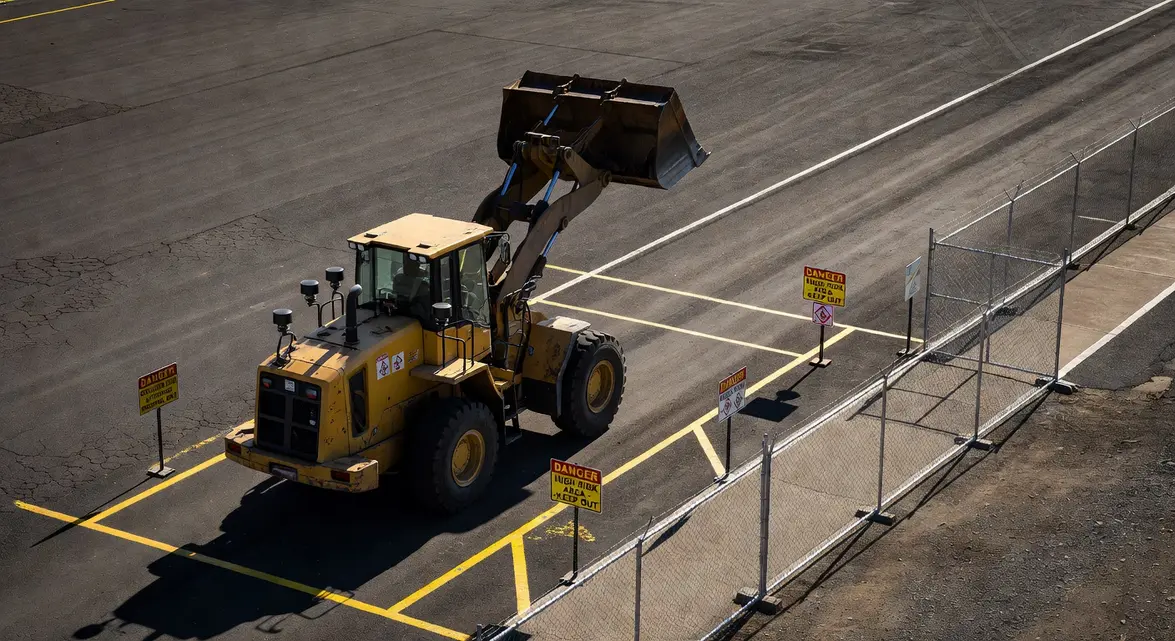
On May 26, 2026, at approximately 11 a.m., a contract dump-truck driver roughly 60 years old was fatally struck by a front-end loader at the Preferred Materials Inc. asphalt plant on New Berlin Road in Jacksonville, Florida. The victim had arrived on site to pick up asphalt and approached the front of the moving loader. The loader operator remained unaware of the collision until completing a turn and discovering the victim beneath the equipment. Video evidence from plant cameras and truck-mounted systems confirmed that the loader’s bucket position created front end loader blind spots that fully obstructed the operator’s view of the pedestrian in the travel path.
Jacksonville Sheriff’s Office investigators classified the event as an industrial accident with no criminal intent. The victim was not a plant employee but a visiting contractor. OSHA has opened an independent investigation into the circumstances. The immediate cause was the pedestrian entering the loader’s active travel path inside an area hidden by equipment geometry, highlighting how front end loader blind spots can eliminate any chance of visual detection during routine operations.
Core safety lesson
The Hazard: Mobile-equipment blind spots and line-of-fire exposure created by equipment geometry such as raised buckets on front-end loaders.
The Control: Install and maintain 360° camera or radar-based proximity-warning systems on all mobile equipment while establishing designated pedestrian exclusion zones enforced by physical barriers or electronic geofencing.
Front end loader blind spots are not minor visibility gaps; they are engineered obstructions that can completely hide a person standing directly ahead of the machine. When a loader turns or reverses with the bucket raised, the operator loses all forward reference points, turning routine movement into an uncontrolled hazard. Relying solely on the operator’s line of sight has repeatedly proven insufficient in industrial environments where multiple contractors and vehicles interact.
Physical separation and electronic detection must therefore function as the primary defenses. A site-specific traffic-control plan that routes pedestrians along protected walkways, combined with mandatory spotters using radio confirmation before any loader movement, removes the possibility of accidental entry into blind zones. These measures are non-negotiable because the cost of failure is immediate and irreversible, as demonstrated by the May 26 event where no such layered controls were in place to interrupt the sequence.
Supervisor’s discussion guide
Q1: “Looking at our own equipment today, where is the biggest risk of front end loader blind spots?”
Q2: “What physical barriers or geofencing could we add this week to keep visiting drivers out of active loader paths?”
Q3: “How do we currently confirm that a spotter has acknowledged a loader’s intended movement before it begins turning or reversing?”
Q4: “If a contractor arrives to load material, what exact steps must they follow before walking near any mobile equipment?”
Action plan & inspection
- Verify that every front-end loader on site has a functioning 360° camera or radar proximity system and document the inspection.
- Walk the plant layout and confirm all pedestrian walkways are marked with physical barriers or clear signage separating them from loader travel routes.
- Review the current traffic-control plan with the site safety representative and update it to require spotter acknowledgment before any loader turn or reverse.
- Confirm that all contractors scheduled for the next 48 hours have received the site-specific signals and radio protocol briefing.
- Schedule a follow-up check within one week to ensure new camera or warning-system installations are operational and logged.
Key takeaways
Front end loader blind spots remain a persistent and lethal hazard whenever equipment geometry blocks the operator’s view of pedestrians. The May 26 fatality at the Jacksonville asphalt plant demonstrates that even experienced operators cannot overcome these obstructions without engineered controls and strict separation protocols.
Every supervisor must treat camera systems, exclusion zones, and mandatory spotter communication as daily requirements rather than optional enhancements. Consistent enforcement of these measures directly prevents the exact sequence of events that led to the loss of the contract driver and protects all personnel who enter active work areas.
Source & Disclaimer: This toolbox talk is for educational purposes based on public report. Read Original Report