
Meeting details
Topic: Explosives licence appeal and regulatory compliance at licensed sites
Goal: This toolbox talk on explosives licence appeal will review the ongoing regulatory challenge at Faldingworth Base and prevent similar accidents in 2026.
The incident: what happened?
The recent explosives licence appeal centres on Faldingworth Defence Limited (FDL) challenging a variation imposed by the Health and Safety Executive (HSE) on the company’s explosives licence at Faldingworth Base, Spridlington Road, LN8 3SQ. The variation, issued under Regulation 16 of the Explosives Regulations 2014, addressed separation distances and enforcement actions. FDL argues that the HSE has not identified any material change in site circumstances to justify the alterations, and the appeal is scheduled for hearing on 15 and 16 June 2026 at Henderson Chambers, London.
Grounds cited by the appellant include incorrect application of Regulation 16(1)(a) and claims that the imposed changes to separation distances are disproportionate. This regulatory dispute highlights the critical need for operators to maintain precise control over explosives quantities, tenant coordination, and licence conditions to avoid any drift that could compromise safety at shared or multi-operator sites.
Core safety lesson
The Hazard: Uncontrolled detonation or explosion of stored explosives due to inadequate separation distances between storage units or between storage and occupied buildings.
The Control: Maintain strict adherence to prescribed minimum separation distances as set out in the Explosives Regulations 2014 and any site-specific licence conditions; conduct regular independent audits to verify compliance.
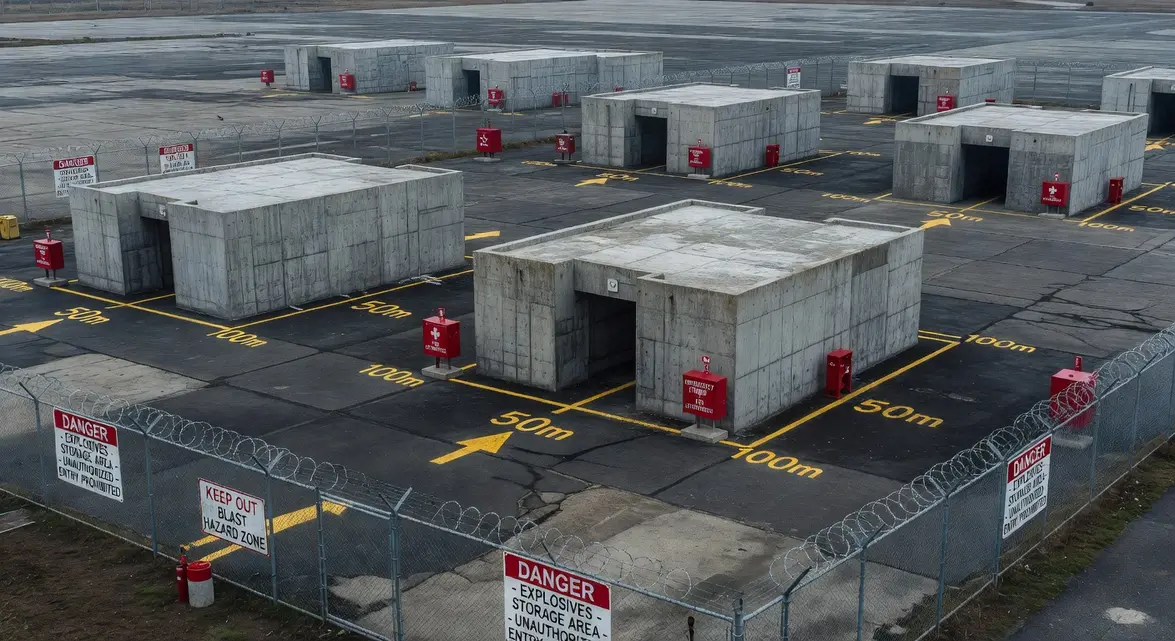
Separation distances are calculated to limit the effects of an explosion to acceptable levels. Any reduction, whether through gradual site changes or misinterpretation of licence conditions, can allow blast effects or fragmentation to reach other storage units or occupied areas. The explosives licence appeal demonstrates how quickly a regulator may intervene when these distances are questioned, underscoring that operators cannot rely on historical approvals alone.
Regular independent audits close the gap between documented licence conditions and actual site layout. Without them, small modifications such as new tenant activities or relocated storage can silently erode the original safety margins. Compliance is therefore non-negotiable because the regulations exist to protect both workers and the public from catastrophic consequences that cannot be reversed once an explosion occurs.
Supervisor’s discussion guide
Q1: “Looking at our own equipment today, where is the biggest risk of inadequate separation distances between explosives stores?”
Q2: “How do we currently verify that all tenant activities remain within the quantities and types permitted by our explosives licence?”
Q3: “What process would we follow if a material change occurred on site that might affect our explosives licence appeal position?”
Q4: “Are our current audit records sufficient to demonstrate ongoing compliance ahead of any regulatory review?”
Action plan & inspection
- Measure and record actual separation distances between all explosives storage units and occupied buildings against current licence conditions.
- Review the site-wide safety case for any tenant or quantity changes since the last HSE inspection.
- Confirm that all required signage and access controls around storage areas remain clearly visible and unobstructed.
- Verify that emergency response plans include updated separation-distance data and evacuation routes.
- Schedule the next independent compliance audit and ensure findings are logged for future regulatory reference.
Key takeaways
Explosives storage safety depends on unchanging adherence to separation distances and licence conditions. The current explosives licence appeal serves as a reminder that regulators will act when they perceive any risk of drift, and operators must be able to demonstrate continuous compliance through records and audits.
Supervisors must treat every potential change to site layout or tenant activity as a trigger for immediate review. Only by maintaining rigorous controls can sites avoid regulatory action and, more importantly, prevent the uncontrolled detonation that the Explosives Regulations 2014 are designed to eliminate.
Source & Disclaimer: This toolbox talk is for educational purposes based on public report. Read Original Report
