Meeting details
Date: April 13, 2026
Topic: Preventing Roller Deck Gap Hazards
Goal: This toolbox talk on roller deck gap hazards will review the MM Flowers Limited worker leg amputation incident and prevent similar accidents in 2026.
The incident: what happened?
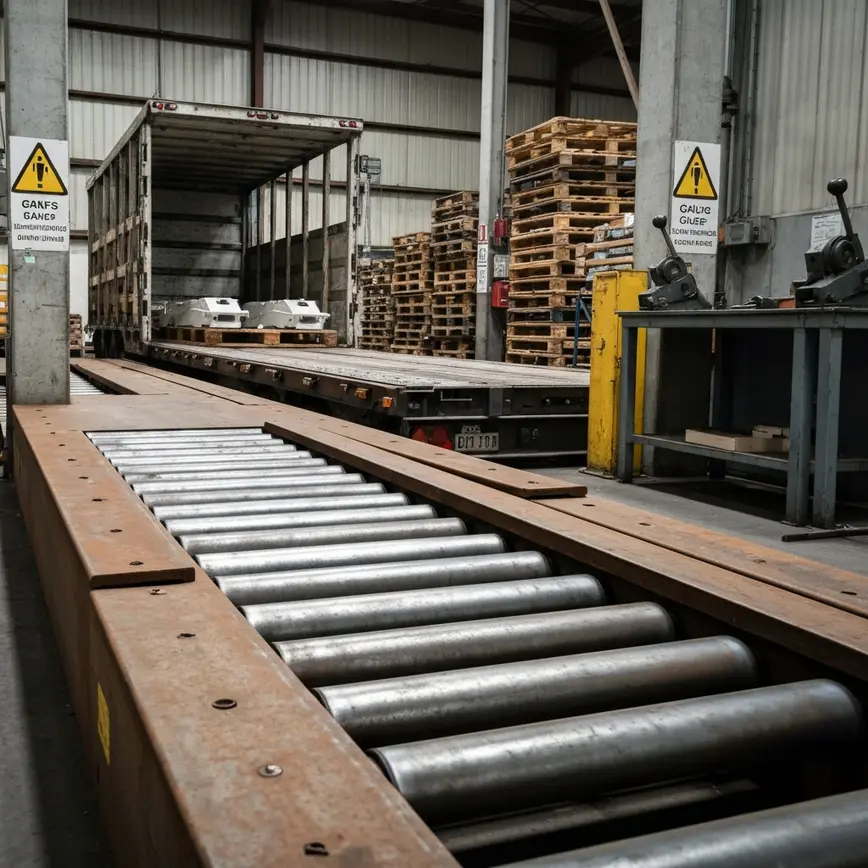
On 4 February 2023, at MM Flowers Limited’s processing facility in Alconbury Weald, Huntingdon, UK, worker Andy Hazelden was manually unloading stuck cargo—aircraft skids—from a delivery trailer ahead of Valentine’s Day. While stepping onto a roller deck, he encountered unprotected roller deck gap hazards: a 10cm gap that trapped his left leg. As the skid was freed, it struck his trapped leg, causing severe injuries that resulted in a through-knee amputation. He remained conscious throughout the ordeal, even hearing his blood hit the floor, a terrifying experience that underscored the immediate life-threatening nature of such incidents.
Andy now relies on a wheelchair, prosthetic limbs, and full-time spousal care, and he can no longer ride motorcycles, a passion stripped away by this preventable accident. The HSE investigation revealed critical failures in safe unloading systems and the unaddressed gap on the roller deck. MM Flowers Limited pleaded guilty to breaching Section 2(1) of the Health and Safety at Work etc. Act 1974, receiving a £134,000 fine plus costs at Peterborough Magistrates’ Court on 10 April 2026. This case highlights how roller deck gap hazards, combined with unsafe manual interventions, can lead to catastrophic outcomes.
Core safety lesson
The technical failure stemmed from an inadequate safe system of work in the cargo intake area, where workers were allowed to climb onto roller decks with known roller deck gap hazards and near moving or stuck loads. Root causes included no physical guards over the 10cm gap, reliance on manual freeing of cargo without mechanical aids, and absence of proper risk assessments prohibiting access to hazardous zones.
The Hazard: Unprotected 10cm gaps in roller decks pose severe risks of foot or leg entrapment, amplified by struck-by dangers from dislodged cargo like aircraft skids during unloading.
The Control: Install physical guards, barriers, or infill plates over all gaps to eliminate stepping hazards, alongside mechanical aids (e.g., levers, vibrators, or powered unloaders) and redesigned processes to avoid manual interventions. Conduct thorough risk assessments, method statements, training, signage, and strict procedures prohibiting access until loads are secured.
This control is non-negotiable because gaps as small as 10cm can instantly trap limbs under dynamic loads, leading to crush injuries or amputations with lifelong consequences, as seen in this case. Mechanical aids reduce struck-by risks by eliminating the need for workers to position themselves in pinch points. Risk assessments ensure site-specific hazards like roller deck gap hazards are identified and engineered out upfront, complying with legal duties under HSWA Section 2(1) and preventing fines, prosecutions, and human suffering. Supervisors must enforce these as zero-tolerance standards—partial measures fail when lives are at stake.
Supervisor’s discussion guide
Use these questions to engage the crew for 5 minutes, encouraging honest input on site-specific risks:
- Q1: “Looking at our own equipment today, where is the biggest risk of roller deck gap hazards?”
- Q2: “What manual unloading practices do we still use that could expose us to struck-by risks from stuck cargo?”
- Q3: “How can we improve our risk assessments to ensure no one accesses hazardous zones like roller decks until loads are secure?”
- Q4: “If you spotted an unprotected gap tomorrow, what would your immediate action be, and who would you report it to?”
Action plan & inspection
Immediately after this meeting, conduct these 5 mandatory checks and document findings:
- Inspect all roller decks and cargo handling areas for gaps ≥5cm; measure and install infill plates or guards where found.
- Verify mechanical aids (levers, vibrators, powered unloaders) are available and operational for stuck loads—no manual freeing allowed.
- Review and update risk assessments/method statements for all unloading processes, prohibiting access to decks until loads are secured.
- Post signage at cargo intake areas warning of roller deck gap hazards and safe zones.
- Train crew on reporting hazards; assign buddies to spot-check equipment daily for the next week.
Key takeaways
Roller deck gap hazards are silent killers in cargo handling— a mere 10cm opening trapped a worker’s leg, leading to amputation and irreversible life changes. Never underestimate small gaps near moving loads; always engineer them out with guards and use mechanical solutions over manual risks. This MM Flowers incident proves that skipping risk assessments and safe systems invites disaster, fines, and guilt—prioritize prevention every shift.
Commit to zero tolerance: inspect today, train tomorrow, and audit weekly. By addressing roller deck gap hazards proactively, we protect limbs, livelihoods, and our legal standing under HSWA. Supervisors, lead by example—safety isn’t optional; it’s your duty.
Source & Disclaimer: This toolbox talk is for educational purposes based on public report. Read Original Report