Meeting details
Date: April 07, 2026
Topic: Machinery Malfunction Prevention
Goal: This toolbox talk on machinery malfunction prevention will review the McCormick & Co. machinery malfunction incident and prevent similar accidents in 2026.
The incident: what happened?
On Monday, April 6, 2026, at approximately 2:15 pm, a machinery malfunction at the McCormick & Co. facility on the 11100 block of McCormick Road in Hunt Valley, Maryland, resulted in four workers being injured. Three sustained non-life-threatening injuries, while one suffered serious injuries requiring airlift to Shock Trauma. This incident underscores the critical importance of machinery malfunction prevention, as an unspecified mechanical failure—potentially involving component breakdown such as moving parts or pressure buildup—caught workers off guard despite no chemical release being reported.
The emergency response was swift, involving the Baltimore County Fire Department and a HazMat team, with no threat to the community identified. The facility was immediately evacuated, and operations were halted until cleared at 6 p.m. The affected equipment was taken out of service, emergency protocols were activated by the company, and investigations are now underway by both McCormick & Co. and the Maryland Occupational Safety and Health (MOSH) administration. Corrective actions are planned before any restart, highlighting the need for robust post-incident analysis to bolster machinery malfunction prevention measures across all sites.
Core safety lesson
The technical failure in this incident stemmed from a mechanical breakdown in industrial machinery, which propelled injuries to four workers. Such malfunctions can arise from wear on moving parts, undetected pressure anomalies, or overlooked maintenance gaps, turning routine operations into high-risk scenarios without warning.
The Hazard: Mechanical failure of machinery, including risks from unguarded moving parts, pressure buildup, or component degradation that can occur suddenly and without prior audible or visual cues.
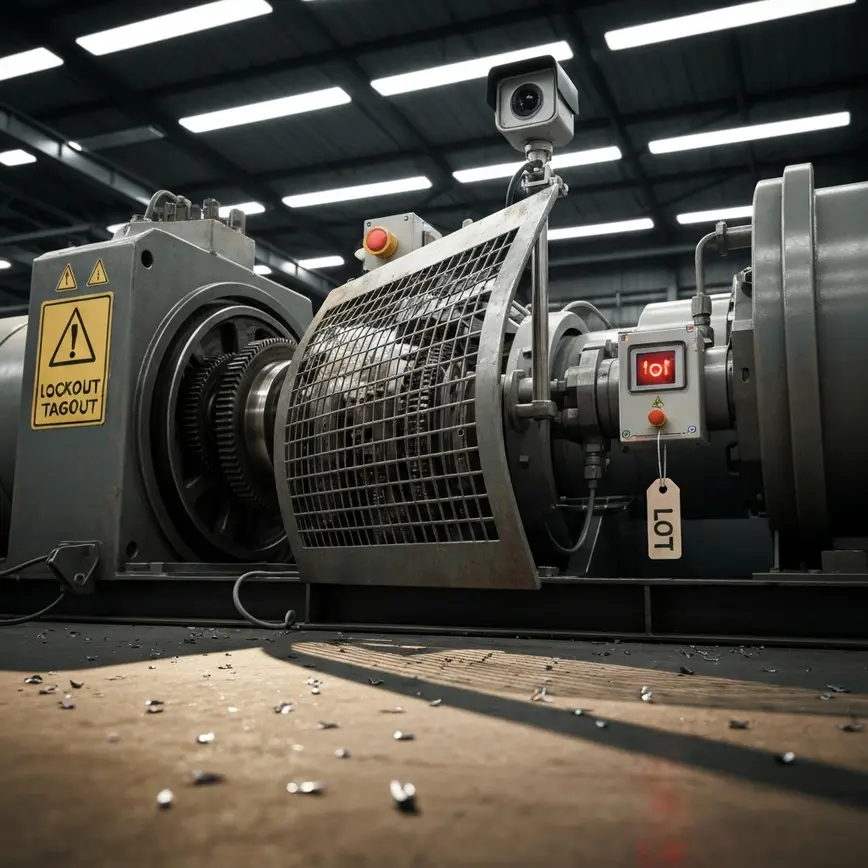
The Control: Implement regular preventive maintenance schedules using predictive analytics like vibration monitoring and thermal imaging, combined with strict lockout/tagout (LOTO) procedures to isolate all energy sources during servicing. Additional layers include machine guarding with interlocked barriers or light curtains and IoT sensors for real-time anomaly detection with automatic alerts.
These controls are non-negotiable because machinery malfunction prevention relies on proactive intervention before failures escalate. Reactive fixes post-injury, as seen in the McCormick incident, lead to evacuations, investigations, and downtime—costing time, resources, and worker well-being. Predictive maintenance detects issues early via data trends, while LOTO ensures zero energy during repairs, preventing unexpected startups that could cause catastrophic harm. Integrating real-time sensors and automated shutdowns creates multiple defense layers, making survival of a single failure point impossible and embedding machinery malfunction prevention into daily operations.
Supervisor’s discussion guide
Use these questions to engage the crew in a 10-minute dialogue, encouraging honest input on site-specific risks:
- Q1: “Looking at our own equipment today, where is the biggest risk of mechanical failure?”
- Q2: “How confident are you in our current lockout/tagout procedures, and what improvements could enhance machinery malfunction prevention?”
- Q3: “Have you noticed any unusual vibrations, noises, or heat from machines lately that we should log for maintenance?”
- Q4: “What role do emergency stop buttons and evacuation drills play in our response to a potential machinery malfunction?”
Action plan & inspection
Immediately after this meeting, supervisors must conduct these 5 checks and document findings:
- Inspect all machinery for signs of wear, such as unusual vibrations, leaks, or damaged guards, and schedule predictive maintenance scans (vibration/thermal) within 24 hours.
- Verify lockout/tagout kits are fully stocked and accessible at every machine station, with tags dated and energy isolation points clearly marked.
- Test emergency stop buttons and automated shutdown systems on high-risk equipment to ensure immediate response.
- Review and update IoT sensor data logs for real-time anomaly alerts, confirming notifications route to supervisors’ devices.
- Walk evacuation routes, confirming signage, clear paths, and assembly points are unobstructed for machinery failure scenarios.
Key takeaways
The McCormick & Co. incident reminds us that machinery malfunctions can injure multiple workers in seconds, as evidenced by four injuries including one airlift. Effective machinery malfunction prevention demands unwavering commitment to preventive maintenance, LOTO, machine guarding, and real-time monitoring—controls that transform potential disasters into managed routines. Supervisors must lead by enforcing these daily, turning lessons from Hunt Valley into zero-tolerance standards for 2026.
Every team member plays a role: report anomalies immediately, participate in drills, and prioritize protocols over production pressure. By embedding machinery malfunction prevention into our culture, we protect lives, minimize downtime, and uphold our safety record. Sign off below to confirm understanding and commitment.
Source & Disclaimer: This toolbox talk is for educational purposes based on public report. Read Original Report