Meeting details
Date: February 04, 2026
Topic: Machinery Isolation & Forklift Blind Spots
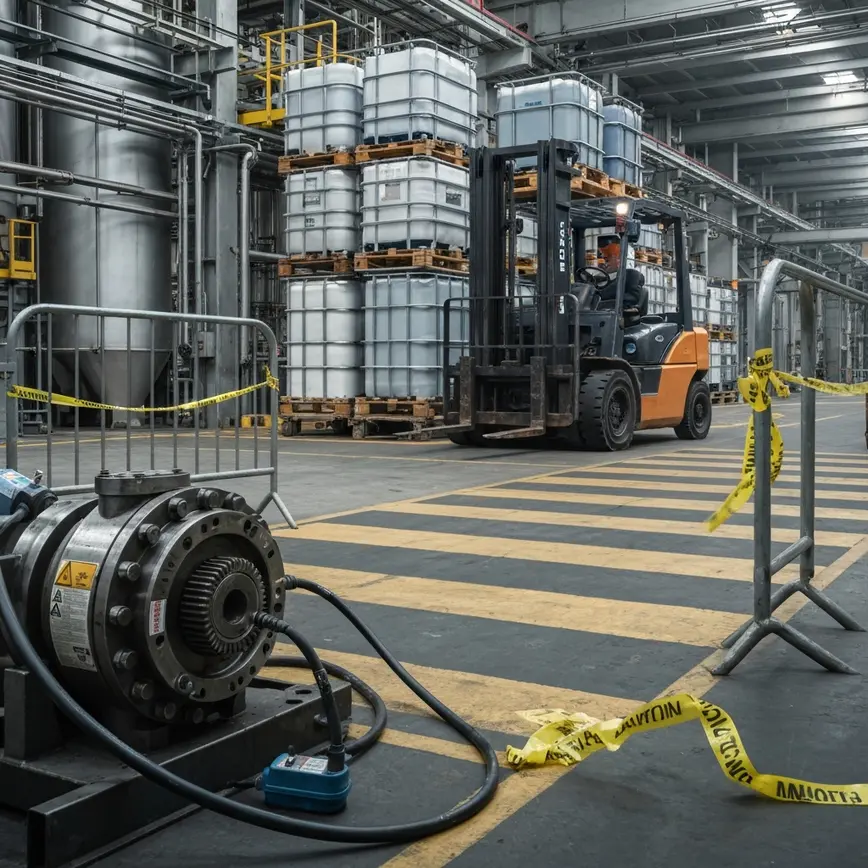
Goal: This toolbox talk on machinery isolation forklift blind spots will review the Exwold Technology Limited incidents at their Hartlepool and Billingham sites and prevent similar accidents in 2026.
The incident: what happened?
Exwold Technology Limited, a chemical manufacturer based in Hartlepool, was fined £50,000 at Teesside Magistrates’ Court on 29 January 2026 for two breaches of Section 2(1) of the Health and Safety at Work etc. Act 1974. These penalties stemmed from HSE investigations into serious incidents where failures in machinery isolation forklift blind spots led to devastating injuries. On 3 September 2021 at the Haverton Hill site in Billingham, an employee suffered the amputation of four fingers on his left hand while checking airflow on a rotary valve during production line preparation between cleaning operations. The valve blades were not effectively isolated from the power supply, allowing them to move unexpectedly.
Just over two months later, on 24 November 2021 at the Brenda Road site in Hartlepool, a second employee was struck by a forklift truck because the driver’s view was obscured by the load, leaving the driver unaware of the pedestrian walking in front. The company had failed to implement suitable isolation procedures for machinery during cleaning and maintenance, as well as proper management of forklift operations, including pedestrian routes. Additional penalties included £10,492.19 in costs and a £190 victim surcharge, highlighting the severe consequences of neglecting machinery isolation forklift blind spots.
Core safety lesson
The technical failures at Exwold Technology Limited exposed critical vulnerabilities in machinery isolation forklift blind spots. In the first incident, the rotary valve was not properly de-energized, turning a routine airflow check into a life-altering amputation. The second incident demonstrated how oversized loads on forklifts create deadly blind spots, compounded by the absence of segregated pedestrian and vehicle routes.
The Hazard: Inadequate isolation of machinery from power sources during cleaning/maintenance and obscured visibility for forklift drivers due to oversized loads, combined with a lack of segregated pedestrian and vehicle routes.
The Control: Implement effective lockout/tagout (LOTO) procedures per HSE guidance (HSG253), including verifiable isolation of all energy sources before any access or checks. Enforce load size limits and use visibility aids like mirrors or spotters as outlined in HSE’s workplace transport safety guide (HSG136). Designate and enforce one-way traffic systems, barriers, and marked pedestrian walkways to separate routes, per HSE HSG136 standards.
These controls are non-negotiable because energy isolation prevents unexpected startups that can cause amputations or fatalities—HSE data shows machinery accidents remain a leading cause of workplace injuries. Similarly, forklift blind spots contribute to hundreds of collisions annually; without strict segregation and visibility measures, pedestrians enter kill zones unknowingly. Supervisors must enforce these daily, as partial compliance invites disaster, fines, and legal liability under the Health and Safety at Work etc. Act 1974.
Supervisor’s discussion guide
Use these questions to engage the crew for 3-4 minutes. Encourage honest input and note responses for follow-up.
Q1: “Looking at our own equipment today, where is the biggest risk of machinery isolation forklift blind spots?”
Q2: “Have you ever seen a LOTO procedure skipped during cleaning or maintenance? What happened?”
Q3: “In our forklift areas, how do we ensure loads don’t obscure the driver’s view, and are pedestrian routes fully segregated?”
Q4: “What one change could we make tomorrow to better address machinery isolation forklift blind spots on site?”
Action plan & inspection
Immediately after this toolbox talk, conduct these 5 checks and document completion. Assign owners and due dates.
- Inspect all rotary valves and similar machinery for LOTO devices; verify isolation procedures are posted and energy sources identifiable.
- Audit forklift loads for size compliance—measure against visibility standards and reject oversized pallets.
- Map and mark pedestrian walkways in forklift zones with barriers; confirm one-way traffic signage is visible and enforced.
- Test visibility aids on all forklifts (mirrors, horns, lights) and schedule spotter training if needed.
- Review and update site risk assessments for cleaning/maintenance tasks, incorporating HSE HSG253 and HSG136 guidance.
Key takeaways
Machinery isolation forklift blind spots are silent killers on site—Exwold’s £50,000 fine and two amputations/collisions prove that skipping LOTO or allowing oversized loads without segregation leads to irreversible harm. Every supervisor must champion verifiable isolation of energy sources before any maintenance and enforce strict forklift protocols, including load limits and separated routes, to protect lives.
Commit to these HSE-aligned controls today: LOTO per HSG253, visibility aids and barriers per HSG136. No shortcuts—your vigilance prevents the next headline. Sign off below to confirm understanding and action.
Source & Disclaimer: This toolbox talk is for educational purposes based on public report. Read Original Report