Meeting details
Topic: Petrol Bomb Training Burns: Lessons from Derbyshire Police Incident
Goal: This toolbox talk on petrol bomb training burns will review the Derbyshire Police riot training exercise at Rotherham and prevent similar accidents in 2026.
The incident: what happened?
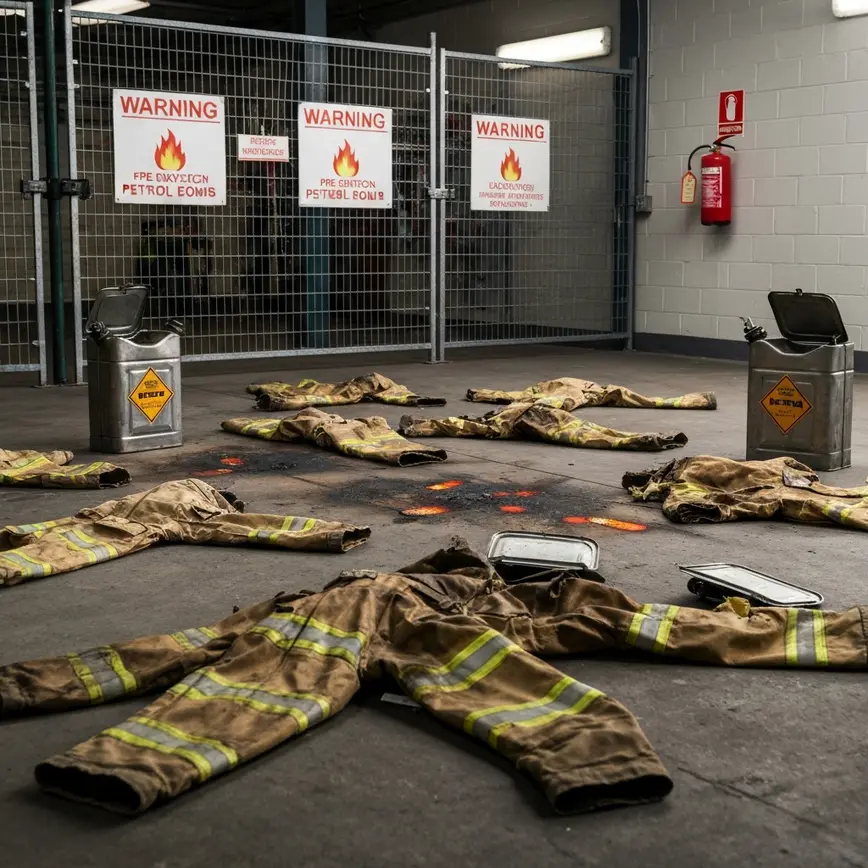
During a public disorder simulation riot training exercise at a Rotherham facility on February 2, 2021, Derbyshire Police officers experienced severe petrol bomb training burns when four out of 13 participants sustained lower body burns from live petrol bombs thrown by fellow officers. The incident led to Derbyshire Police being fined £60,000 by Sheffield Magistrates Court on January 19, 2026, after pleading guilty to breaching Section 2(1) of the Health and Safety at Work etc. Act 1974, following a thorough HSE investigation. Despite wearing flame-retardant PPE, the officers suffered injuries because the equipment failed to provide adequate protection, exacerbated by improper planning in producing and deploying the petrol bombs, and a complete lack of risk assessment for the high-risk elements of the drill.
Three of the injured officers required hospital treatment, resulting in permanent scarring and psychological harm for those affected, though all eventually returned to work. Key failures included insufficient guidance on the lifespan, care, and inspection of flame-retardant PPE, uncontrolled production and throwing of live petrol bombs without safe alternatives, and no safe systems of work to manage foreseeable risks like petrol exposure during the exercise. This incident underscores how even trained professionals can face catastrophic consequences from overlooked safety basics in simulated high-hazard scenarios.
Core safety lesson
The Derbyshire Police case exemplifies how petrol bomb training burns arise from multiple interconnected failures, primarily inadequate PPE maintenance, uncontrolled hazardous materials handling, and absent risk assessments. These are not isolated oversights but systemic lapses that turn training into tragedy.
The Hazard: Inadequate PPE maintenance and information, combined with uncontrolled petrol bomb production and deployment, and absence of safe systems of work in high-risk simulations.
The Control: Mandatory training and documentation on PPE inspection, maintenance schedules, and replacement; thorough, documented risk assessments prioritizing elimination or engineering controls like inert simulators; and enforced standard operating procedures with emergency protocols, medical standby, and independent expert reviews.
These controls are non-negotiable because high-risk activities like petrol bomb training inherently involve flammable materials and foreseeable burn risks that demand hierarchical risk management—eliminate where possible, then engineer barriers, before relying on administrative or PPE measures. Without documented risk assessments, teams operate blindly, as seen when flame-retardant PPE degraded unnoticed, failing under real flames. Proper PPE protocols ensure equipment integrity through pre-use checks and lifecycles, preventing false security. Safe systems of work, verified by experts, embed emergency responses, limiting exposure and enabling rapid mitigation, ultimately protecting lives and avoiding legal repercussions like the £60,000 fine and reputational damage.
Supervisor’s discussion guide
Engage your crew with these questions to drive home the petrol bomb training burns lessons:
Q1: “Looking at our own equipment today, where is the biggest risk of inadequate PPE maintenance leading to burns in training?”
Q2: “How would we handle production and deployment of simulated hazards like petrol bombs—have we documented a full risk assessment?”
Q3: “What safe systems of work are missing in our high-risk drills that could prevent uncontrolled exposures?”
Q4: “If we faced petrol bomb training burns tomorrow, what’s our immediate emergency protocol and who verifies it?”
Action plan & inspection
- Inspect all flame-retardant PPE for wear, damage, or expiration dates; document findings and replace non-compliant items immediately.
- Conduct and document a site-specific risk assessment for any high-risk training involving flammables or simulations, prioritizing inert alternatives.
- Review and update standard operating procedures for hazardous material handling, including petrol storage and exposure controls.
- Schedule mandatory PPE maintenance training for all team members, with pre-use checklists signed off by supervisors.
- Verify emergency protocols: confirm medical standby availability, fire suppression readiness, and independent safety expert sign-off for upcoming drills.
Key takeaways
The Derbyshire Police petrol bomb training burns incident is a stark reminder that no training exercise is worth risking permanent injury or psychological harm. Fines, prosecutions, and HSE scrutiny follow when basics like risk assessments, PPE integrity, and safe systems fail—£60,000 and guilty pleas prove the high cost of complacency. Supervisors must lead by enforcing documented controls, from PPE inspections to hierarchical hazard elimination, ensuring every simulation prioritizes safety over realism.
Implement these lessons today: thorough planning prevents petrol bomb training burns tomorrow. Return to work safer, with crews empowered by knowledge, verified checks, and a culture where safety is non-negotiable. All returned to duty post-incident, but prevention ensures no one needs hospital care or scars.
Source & Disclaimer: This toolbox talk is for educational purposes based on public report. Read Original Report