Meeting details
Topic: Immediate Review of Critical Safety Protocols and Construction Fatality Prevention
Goal: This toolbox talk on construction fatality prevention will review the recent tragic incident at Converse Elementary School and reinforce protocols necessary to prevent similar accidents in 2026.
The incident: what happened?
Yesterday, January 7, 2026, the construction industry suffered another tragic loss. A 63-year-old worker, Baltazar Rubio-Olvera, died while working on the Converse Elementary School campus, a project managed by Judson ISD in Converse, Texas. While the exact cause and manner of death are still pending investigation by the Bexar County Medical Examiner’s Office and local authorities, this incident serves as a stark, immediate reminder of why rigorous safety standards are paramount for effective construction fatality prevention.
The victim was employed by a third-party contractor working under General Contractor DL Bandy. Regardless of the final determination—whether it involves trauma, equipment failure, or a sudden medical event—the site environment must be managed to minimize all foreseeable risks. Our immediate response cannot wait for the final report; we must analyze the high-risk hazards inherent to all active construction sites and ensure every control measure is fully operational today. Judson ISD has confirmed they are cooperating fully with local authorities during this ongoing investigation.
Reinforcing Fall Protection Protocols
The Hazard: Falls from Elevation. This remains the number one killer in the construction sector year after year. Even if the incident at Converse Elementary is ultimately attributed to another cause, we cannot ignore the persistent, lethal threat posed by working at height.
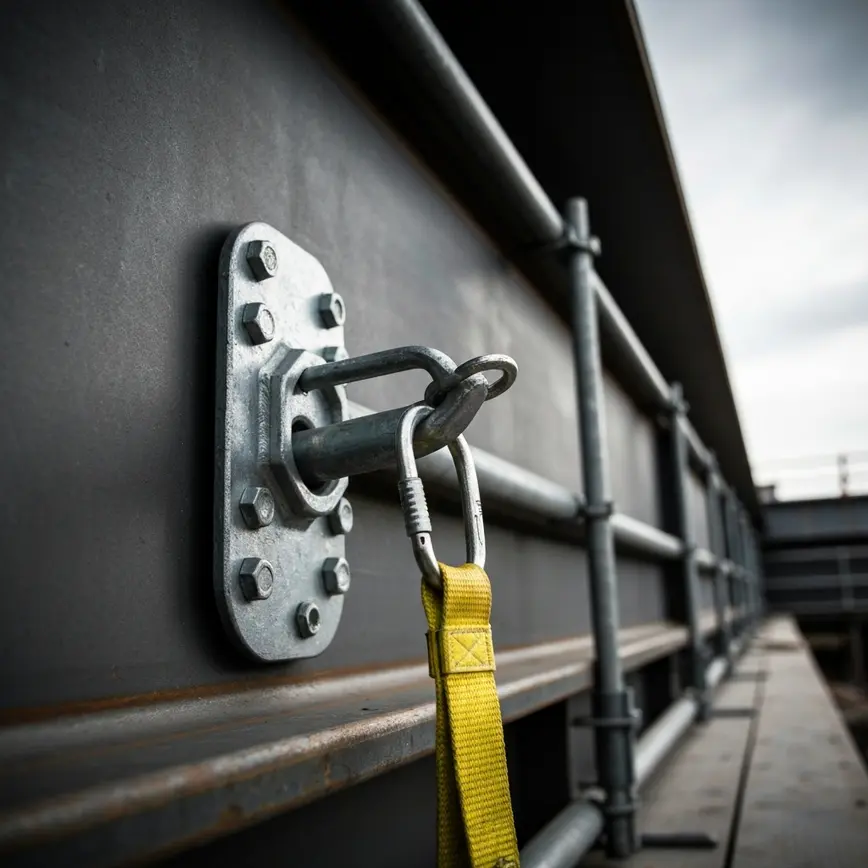
The Control: We mandate 100% tie-off requirements for all personnel working at 6 feet or higher. This is non-negotiable. Every worker must be trained, inspected, and observed utilizing a Personal Fall Arrest System (PFAS) correctly. This includes ensuring anchor points are certified to 5,000 lbs per worker, harnesses are properly fitted, and lanyards are inspected daily for wear, cuts, or damage.
The implementation of passive controls, such as guardrails on all open edges, scaffolding, and elevated platforms, is equally critical. These systems must be erected by competent persons and inspected prior to use. Relying solely on active systems (PFAS) is insufficient; a layered approach to construction fatality prevention is required. Supervisors must verify that all access points are secure and that temporary openings are covered and clearly marked before the start of every shift.
Supervisor’s discussion guide
- Q1: “Looking at our own equipment today, where is the biggest risk of Falls from Elevation?”
- Q2: “When was the last time we conducted a hands-on inspection of our PFAS gear? What specific defects are we looking for?”
- Q3: “Given the recent incident, what immediate, proactive steps can we take right now to improve our construction fatality prevention plan on this site?”
- Q4: “If a co-worker shows signs of physical distress or fatigue, what is the immediate protocol for stopping work and ensuring medical attention?”
Action plan & inspection
The following five items must be inspected and verified immediately following this toolbox talk:
- Verify all guardrails on elevated platforms (scaffolding, roofs, leading edges) are intact, properly secured, and meet height requirements.
- Conduct a mandatory, documented inspection of all Personal Fall Arrest Systems (harnesses, lanyards, anchor points) currently in use. Remove any defective equipment from service immediately.
- Confirm that exclusion zones around heavy equipment (cranes, forklifts, excavators) are clearly marked and enforced by spotters.
- Review the site emergency action plan (EAP), ensuring all workers know the exact location of first aid kits, AEDs, and the procedure for calling emergency services.
- Supervisors must observe and confirm 100% compliance with high-visibility PPE requirements for all ground and elevated personnel.
Key takeaways
The death of Baltazar Rubio-Olvera is a profound tragedy that demands our immediate and unwavering focus on site safety. We must treat every day as if a serious incident is imminent. Effective construction fatality prevention is not a checklist item; it is a cultural commitment that starts with leadership and extends to every worker on the ground. We must maintain absolute vigilance regarding the “Fatal Four” hazards—Falls, Struck-By, Caught-In/Between, and Electrocution—and ensure that our controls are proactive, not reactive.
Our commitment to safety means stopping work if conditions are unsafe, reporting near misses immediately, and ensuring that adequate rest and hydration are prioritized, especially for physically demanding tasks. We owe it to our families, our company, and the memory of those lost to ensure that 2026 is defined by zero preventable incidents. Let’s work together to make safety the easiest choice on the job site.
Source & Disclaimer: This toolbox talk is for educational purposes based on public report. Read Original Report