meeting details
Date: January 08, 2026
Topic: Reviewing Critical Controls for Preventing Fatal Workplace Hazards
Goal: This toolbox talk on preventing fatal workplace hazards will review the recent incident in Tammisaari, Finland, and reinforce the critical steps necessary to prevent similar accidents in 2026.
the incident: what happened?
On January 8, 2026, a fatal workplace accident occurred in Tammisaari, Finland, claiming the life of a worker. While the specific details regarding the immediate cause—whether it was a fall, a vehicle incident, or machinery failure—have not yet been publicly released, the outcome is devastatingly clear. This tragedy serves as a stark reminder that even in highly regulated environments, the risk of catastrophic failure is always present, demanding continuous vigilance in implementing and enforcing controls for preventing fatal workplace hazards.
The lack of accessible incident specifics prevents us from analyzing the direct root cause, but it forces us to pivot our focus from reaction to proactive prevention. Every fatal incident, regardless of location or industry (construction, manufacturing, or logistics), highlights the absolute necessity of maintaining robust safety management systems. We must use this somber news to reassess our own site protocols and ensure that our primary defenses against the three most common fatal hazards—Falls, Struck-By/Caught-In, and Hazardous Energy Release—are impenetrable.
core safety lesson
The core safety lesson we draw today focuses on preventing fatal workplace hazards related to mobile equipment and machinery interaction. The most common cause of fatalities in industrial settings involves workers being struck by moving vehicles or caught in unguarded machinery. This is not a matter of speed, but of uncontrolled energy.
The Hazard: Struck-By/Caught-In Hazards (Involving heavy machinery, vehicles, or moving parts.) The Control: Strict adherence to Lockout/Tagout (LOTO) procedures and rigorous traffic management planning. LOTO is non-negotiable; it is the physical barrier that prevents the sudden, uncontrolled release of hazardous energy during servicing or maintenance. A machine that is not locked out is a machine that can kill.
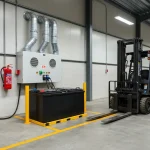
Furthermore, we must eliminate interaction points between pedestrians and heavy equipment. Clear, marked exclusion zones, mandatory spotters, and established traffic flow patterns are essential. If a pedestrian does not need to be near the lift truck path or the operating radius of an excavator, they must not be there. This physical separation is the single most effective control against struck-by fatalities, and it must be enforced by every supervisor, every hour of the day.
supervisor’s discussion guide
Use these questions to facilitate a brief, focused discussion with your crew immediately following this briefing:
- Q1: “Looking at our own equipment today, where is the biggest risk of Struck-By/Caught-In Hazards?”
- Q2: “Can anyone describe a recent instance where they observed a LOTO procedure bypassed or ignored, and what immediate action they took?”
- Q3: “Beyond LOTO, what are three specific administrative controls (like permits or communication protocols) we use for preventing fatal workplace hazards during non-routine maintenance?”
- Q4: “Are our pedestrian walkways clearly delineated, and are workers consistently using them, especially during high-traffic periods? What happens if a walkway is blocked?”
action plan & inspection
The following five items MUST be checked and verified on your site immediately following this toolbox talk:
- Verify all machine guarding is securely fastened and free from damage on rotating equipment.
- Audit three random LOTO devices currently in use to ensure proper application and tagging by authorized personnel.
- Inspect all high-visibility vests and PPE worn by ground guides and spotters for cleanliness and compliance.
- Review the site traffic management plan, specifically checking the clarity of pedestrian-vehicle segregation markings and barriers.
- Confirm that all employees who operate or service machinery have current, documented LOTO training and understand the energy isolation points for their specific equipment.
key takeaways
The tragic news from Tammisaari serves as a powerful, painful reminder that safety is not a checklist—it is a continuous commitment. Our focus on preventing fatal workplace hazards must remain absolute. We cannot afford complacency when dealing with falls, machinery, or stored energy. Every worker must treat LOTO procedures, machine guarding, and traffic controls as life-saving measures, because that is exactly what they are.
We have the tools and the procedures to ensure everyone goes home safely. Supervisors, your role is critical: enforce the controls, audit the systems, and lead by example. If you see a violation of LOTO or a breach of traffic segregation, stop the work immediately. Proactive intervention is the most effective strategy for preventing fatal workplace hazards and ensuring zero incidents on our site in 2026.
Source: Read Original Report